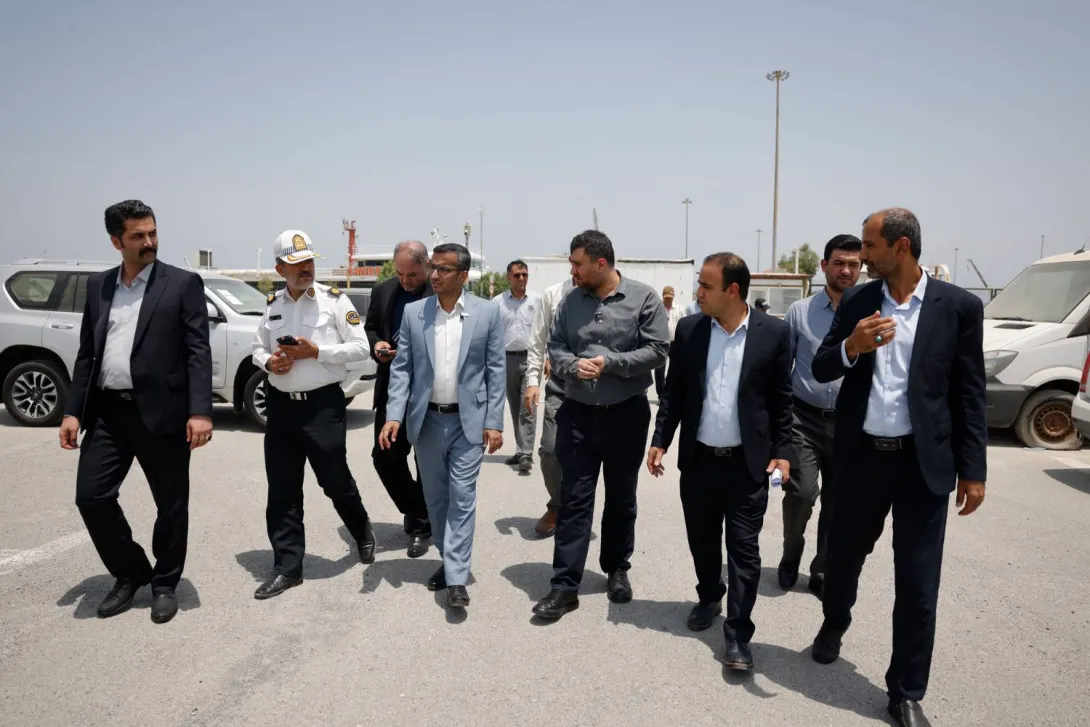
According to the Public Relations and International Affairs of the Kish Free Zone Organization, in a meeting attended by Ali Salmizadeh, Public and Revolutionary Prosecutor of Kish; Kourosh Dastpak, Acting Director of Development and Trade of the Kish Free Zone Organization; Captain Mehdi Shahidi, Acting Chief of Kish Traffic Police; and Captain Hadi Hesari, Chief of Kish Economic Police, legal and executive obstacles in the automotive sector, including duties, after-sales services, types of registration, temporary import vehicles, and the vehicle clearance process were discussed and reviewed.
Ali Salmizadeh, emphasizing the necessity of expediting the handling of visitors' affairs, said: efforts must be made so that people do not face problems in the customs area, and just as matters related to the Kish Free Zone Organization are completed within 72 hours, the processes related to the Customs of the Islamic Republic of Iran should also be completed in the shortest possible time.
The Public and Revolutionary Prosecutor of Kish considered this island a pioneer among the country's free zones and added: the level of public demand in Kish has caused managers to update themselves and to adapt their performance to current needs and conditions in order to better respond to the public's demands.
Kourosh Dastpak, appreciating the public-oriented approach of the Public and Revolutionary Prosecutor of Kish, said: the proposals and reminders raised with the aim of reforming processes, increasing transparency, reducing grounds for corruption, and strengthening public service must be examined and appropriate solutions for their implementation must be developed. In such a way that, while observing laws and regulations, the speed of providing services to clients is not reduced.
He stated that the extension of some mainland laws to free zones has limited the powers of executive agencies to solve people's problems, and added: the cooperation and correspondence of the judiciary on issues such as warehouse receipts and temporary import vehicles has been helpful for the public and the executive body and has resolved the problems of a large portion of those concerned.
The Acting Director of Development and Trade of the Kish Free Zone Organization, criticizing the collection of fees in return for issuing an after-sales service document without having real infrastructures, said: a company that commits to providing after-sales services must have the necessary permits, a repair shop, parts, and the required operational capacity; because issuing a document without the possibility of providing real services is not considered after-sales service.
Dastpak, referring to the mandatory national standard of Iran number 19117 in the field of automotive after-sales services, added: currently, only one company in Kish has succeeded in obtaining this standard and other companies must also take action to obtain the necessary permits and standards. Also, the groundwork for another company's activity should be provided to prevent the creation of a monopoly and the service tariff should be determined by the Commerce Management.
He spoke about the scrappage certificate and the obligation to provide after-sales services and said: the implementation of these items, given the current conditions and the coordination made with the prosecutor's office, is temporarily suspended and if the decision changes, it will be implemented based on the announced regulations.
Dastpak considered the determination of the status of temporary import vehicles among the other issues facing the island and added: these vehicles, except for tourist vehicles subject to special regulations, must return to the country of origin after the two-year period; whereas returning them under current conditions faces technical and executive obstacles and, if a suitable solution is not envisaged, it can lead to increased public visits and social consequences.
Referring to the provision made to change the status of some 2020 and 2021 model vehicles following coordination and the joint interpretation carried out, he said: a large portion of eligible owners have used this possibility; however, for other vehicles approaching the end of the legal period, a solution must also be envisaged within the framework of higher-level laws and the organization's procedures.
The Acting Director of Development and Trade of the Kish Free Zone Organization emphasized: the correspondence made with the judiciary should be aimed at solving general problems, not addressing the issue of a specific individual. Visitors should only be directed to the prosecutor's office when their demand is legitimate, but existing laws, regulations, or procedures have deprived the executive agency of the ability to resolve the issue.
After the end of the meeting, the attendees visited various sections of Kish Customs and were informed about the manner of handling and providing services to visitors.