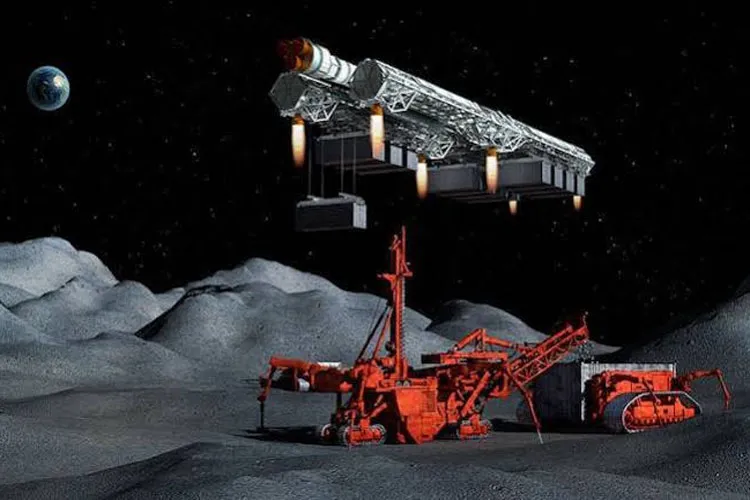
The idea of extracting resources from other celestial bodies is no longer merely science fiction. Scientists are now examining the Moon, asteroids, and planetary moons as potential sources of minerals and other materials that could be important for future missions to explore the solar system.
In this context, NASA is studying a plan to build a small spacecraft that can identify and locate mineral resources from a distance; an approach that could provide valuable information about available resources to scientists before launching complex and costly surface missions to celestial bodies.
A small spacecraft to search for resources
The project, called “Interplanetary Slingshot Resource Surveys,” has been proposed and received funding from NASA’s NIAC program to study innovative and forward-looking ideas and technologies.
The proposed design is based on using a small spacecraft weighing about 300 kilograms. This spacecraft could be equipped with Raman spectroscopy technology; a method that enables investigation of the composition of surface materials on celestial bodies from a distance.
Raman spectroscopy is based on examining how light interacts with matter. Different minerals and compounds produce characteristic patterns when interacting with light, and scientists can obtain information about the chemical composition of materials by analyzing these patterns.
The Moon, asteroids and Phobos on the target list
According to a report published on the Space website, the proposed mission could survey several celestial bodies, including the Moon, a near-Earth asteroid, and Phobos, one of Mars’s two moons.
The main advantage of this approach is reducing the risk of future missions. Landing a spacecraft on a distant celestial body is an extremely complex and costly operation and may take years for design, preparation, and execution.
On the other hand, there is always a possibility that after traveling a long distance, a spacecraft will arrive and it will turn out that the targeted area does not contain the resources scientists expected.
The “slingshot” concept is proposed to solve this very problem. The spacecraft first surveys the surface of the target from a relatively distant range and identifies areas that have higher value in terms of resources. More precise and costly missions can then be sent to the selected areas.
The big challenge: extremely weak Raman signals
Despite the high potential of this technology, its implementation faces a major scientific hurdle: Raman signals are extremely weak.
Estimates for this project indicate that only about one photon out of every 10 trillion photons undergoes Raman scattering. This makes receiving and analyzing these signals from large distances a serious challenge for the equipment and algorithms used.
Researchers are now trying to determine whether reliable measurements can be made from distances of 30 to 50 kilometers using this method. This goal is a considerable distance from previous experiments, which were able to perform Raman measurements from around 120 meters.
A preliminary step toward space mining
If the project succeeds, the proposed technology could provide a new method for mapping resources such as minerals, water ice, and other compounds found on the Moon, asteroids, and planetary moons.
Of course, NASA’s plan does not mean the start of mining in space. The current goal is not extraction; rather, it is identifying them, determining their nature, and locating where they are.
Such a technology could in the future become one of the preliminary stages of space resource exploration; meaning that before spending huge costs on landing and surface operations, it would first be determined which areas truly merit further exploration. If this approach is implemented, it could be one of the important steps in the shift from merely exploring the solar system to the potential utilization of space resources.