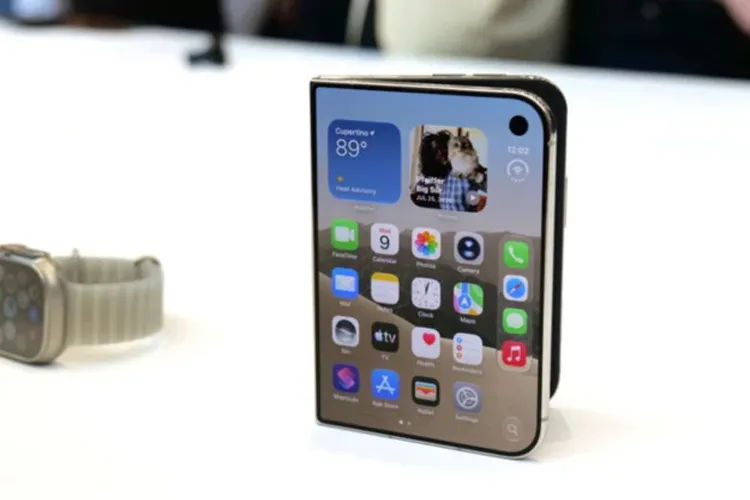
About 10 years have passed since the release of the iPhone X; a product that started a new era in the design of Apple’s flagship phones. Now the company has entered a new realm again with the introduction of the iPhone Duo; a product that could be the most attractive phone or even one of the most exciting Apple gadgets in nearly a decade.
The iPhone Duo is equipped with a 5.4-inch external OLED display and a 7.6-inch flexible OLED panel inside. The design of this phone is somewhat reminiscent of the first-generation Pixel Fold, but Apple has made significant changes and refinements to its body structure.
The body’s rounded edges make opening the phone easier, and the animation that plays when switching from the external display to the internal display is one of the most attractive parts of the Duo experience. This transition is very seamless, and subtle gradient effects and depth of field also give the experience of using Apple’s first foldable phone a special flair.
A beautiful but heavy body
Despite using a titanium frame and having an IP68 rating for water and dust resistance, the iPhone Duo is a relatively heavy phone. This device is 11.3 millimeters thick when closed and weighs 254 grams; as a result, it is considerably heavier and thicker than Samsung’s Galaxy Z Fold 8, which weighs 201 grams and is 9.7 millimeters thick when closed.
A comparison among the iPhone Duo, the Galaxy Z Fold 8 and the first-generation Pixel Fold was supposed to be published to examine the design differences of these devices, but Apple representatives did not agree to this comparison.
The exterior of the Duo houses a full set of buttons including a lock key equipped with Touch ID, a dedicated camera control and a volume control button. Placing the volume button on the top of the phone may seem like a strange choice at first glance, but when constantly switching between portrait and landscape modes, its placement makes complete sense.
Another interesting design detail of the Duo is its precise operation in detecting whether the phone is open and how far it is opened. The device also supports tent and desktop modes. Tent mode can turn the Duo into a standalone clock or calendar. In addition, it is possible to use the phone in a semi-open state, which can be useful for reading e-books.
Apple chose Touch ID instead of Face ID for the Duo. This decision may be logical for users who previously used foldable phones with a fingerprint sensor on the edge; because the fingerprint sensor remains one of the fastest methods for unlocking the phone, making purchases, and accessing various device features.
The fold in the display is almost invisible
Inside the phone, Apple uses a thick nano-matte coating on the main display. This coating, in addition to almost completely reducing distracting reflections, helps hide the display crease.
Of course the Duo’s display is not completely crease-free, but the crease in the middle of the screen is so subtle that in many cases it is felt more by touch than seen by the eye.
One of the interesting features of the internal display is that the FaceTime camera is placed under the display. This camera is almost out of sight when not in use and does not draw much attention in everyday use.
Apple had previously seen under-display camera technology in foldable phones; Samsung also tested it in the Galaxy Z Fold 3 in 2021. However, it seems Samsung has moved away from continued use of this technology in recent years. For this reason, its presence in the iPhone Duo is one of the notable technical features of this phone.
Only when the Duo’s under-display camera is inspected from a close distance can it be noticed. In that case, a ring of pixels above the camera looks glossier than other parts of the main display.
The Duo’s external display is glossy, but the matte surface of the internal display can also make the stylus experience feel more natural. This phone supports the Apple Pencil on both displays. However, during the review, a sample of the Apple Pencil was not provided, and therefore it was not possible to precisely test this capability.
Dual cameras; good, but not complete
On the rear of the iPhone Duo are two cameras. The main camera is a 48-megapixel Fusion sensor that can capture telephoto images with 2x zoom at 12-megapixel resolution. Alongside it is a 48-megapixel ultra-wide camera.
The Duo’s camera array performs well in various lighting conditions and can capture clear images. However, this phone does not benefit from the variable aperture feature found in the iPhone 18 Pro series.
A more important limitation from the reviewer’s perspective is the absence of a dedicated zoom lens with a longer focal length; a feature that is offered in the Galaxy Z Fold 8 Ultra.
In contrast, the camera module’s design has an interesting advantage. This module covers almost the entire width of the phone’s rear and makes the Duo more stable and less prone to wobbling when placed on a table; details that show Apple paid attention to small matters in the product design.
Software; where Apple shows its strength
Perhaps the most striking feature of the iPhone Duo is its smooth and fully polished software experience. This is an important part of the Duo experience and can even explain why Apple waited so long to enter the foldable phone market.
Multitasking on the Duo is designed to be simple and flexible, and users can use it in various ways. For example, you can press and hold an app icon and then choose the split-screen option. Another method is to swipe up from the bottom of the display and move apps to the left or right.
After split-screen mode is activated, it is also possible to drag and drop photos and files from one app to another. Also, by holding the small tab between the two screen sections, you can create a dedicated app pair so that next time access to the desired combination is faster.
In this way, the iPhone Duo brings many of iPadOS’s popular productivity features into a smaller, more portable device.
Apple has finally entered the foldable market
For its first foldable phone, Apple has chosen a set of features and tools previously seen in rival products and placed them in a product that still preserves Apple’s design and software identity.
The iPhone Duo, like the Pixel 11 Pro Fold, uses an IP68 standard for water and dust resistance. Its internal display is also equipped with an under-display camera and a matte coating that reduces light reflection even more than the Galaxy Z Fold 8 display.
On the software side, it also appears that Apple has tried to deliver a seamless and polished experience; an experience that, from the reviewer’s perspective, Samsung, Google and Motorola have not yet been able to reach at the same level on Android phones.
In terms of price, the Duo occupies an interesting position. Its price is $100 less than the Z Fold Ultra and $100 more than the Z Fold 8; a factor that could make it an attractive option in the foldable phone market.
For iPhone fans who for years have watched Android rivals release foldable phones, the Duo, although arriving later than expected to this market, can compete from the start with the best foldable phones available.