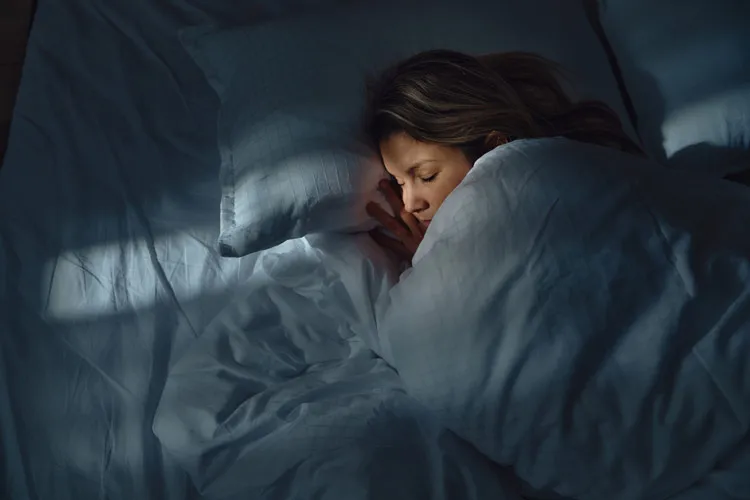
The results of a new study show that even exposure to a small amount of light while sleeping may change the shape and function of the heart muscles and increase the risk of developing heart disease in the future.
According to CNN, in this study published in the European Heart Journal, the sleep of more than 11,000 people who did not have cardiovascular disease was examined.
According to experts, for quality sleep, bedroom lighting should ideally be a maximum of one lux, which is considered completely dark. Lux is the unit of illuminance in the International System of Units. Three lux is roughly equivalent to moonlight or the light that seeps under a closed bedroom door.
Researchers in this study found that the heart muscle walls of people who were exposed to light greater than three lux while sleeping thickened in a way that reduced the heart's pumping efficiency.
Based on the study results, the brighter the bedroom, the greater the damage. Light from a phone screen facing upward, the glow of a digital alarm clock, or outdoor light pollution are among the likely sources of extra light.
All participants in the study wore a sensor on their wrist for seven days to measure light levels during the night. Three years later, each of them underwent an MRI of the heart to examine its structure and function.
The hearts of those who slept in environments brighter than three lux, compared with people who were not exposed to light at night, showed thickening of the left ventricular walls and a reduction in its internal volume. The heart muscle's ability to relax with each beat had also decreased; a change that is one of the early signs of cardiac dysfunction. Other damage was also observed in the heart's two other chambers.
The reshaping of the heart muscle is called cardiac remodeling. This thickening and stiffening of the heart muscle or its excessive enlargement, observed with exposure to extra light and possibly as a result of poor-quality sleep, are not desirable changes.
Researchers added that between 24 and 49 percent of the observed effect on the heart was due to shortened sleep duration to less than five or six hours, which is a direct consequence of exposure to nighttime light. Other factors may play a role in the remaining 51 percent of this risk. Nighttime light exposure may also affect other cardiovascular risk factors such as stress and biological changes like blood pressure and heart rate.
Of course, this study had limitations. For example, one week of testing to measure overall light exposure is relatively short. In addition, using a wrist-worn light sensor is not an appropriate measure of the amount of light the eye receives and may overestimate or underestimate the actual amount. Therefore, linking these data to the cardiac scans performed three years later may seem somewhat far-fetched, and more studies are needed to prove a causal relationship.
How can we make the bedroom darker?
Preventing light from entering the bedroom is relatively easy. Thick curtains or inexpensive blackout blinds can be installed on windows. Of course, don't forget to open the curtains in the morning so daylight can enter the room, as this light helps regulate the body's circadian rhythm.
Turn off hallway lights at night. However, if light still comes in under the door or through window edges, you can use draft stoppers or light-blocking strips. If a small amount of light still remains in the environment, wear a sleep mask while sleeping.
For a bedside reading lamp, choose bulbs with warm white, deep amber, or red light whose effective color temperature is low or near zero. If you need a nightlight, dim it and place it close to the floor.