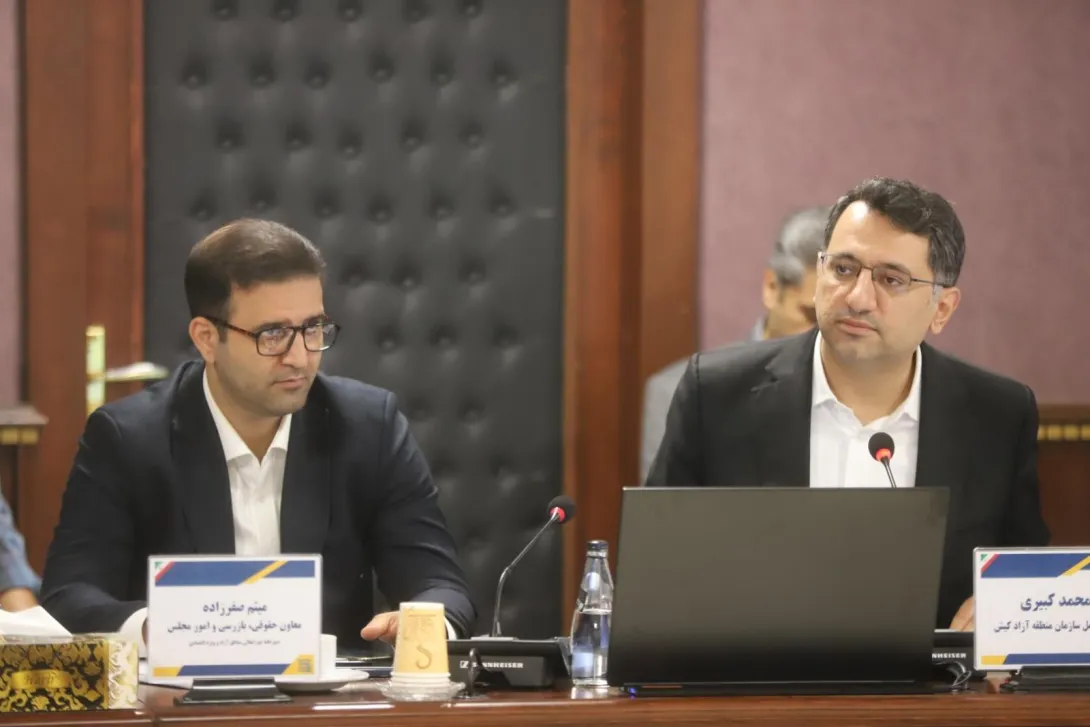
According to the Public Relations and International Affairs of the Kish Free Zone Organization, Mohammad Kabiri, CEO of the Kish Free Zone Organization, at the meeting of the deputies of the secretariat and the CEOs of the free and special economic zone organizations, while appreciating the efforts of the country’s officials to achieve a dignified peace and also the resistance of the Iranian nation, stated: We hope that with the measures taken the shadow of war will be removed from the country and we can pursue the path of the country’s development and progress with more calm.
He also, thanking Hussein Forouzan, Secretary of the Supreme Council of Free-Industrial and Special Economic Zones, for his presence and continuous follow-ups, added: In this opportunity I first want to take a look at the experience of free zones in the world and see what achievements these zones have had for their countries, what characteristics they possess and if we want to use these experiences and the best global practices, what challenges we face in Iran and what the executive solution is.
Kabiri, referring to the extensiveness of free zones in the world, emphasized: More than 169 countries in the world have free zones and special zones and there are more than 6,000 free and special economic zones in the world whose total exports reach about 3,500 billion dollars. These numbers show that free zones play a significant role in the global economy.
He continued: Successful free zones in the world have many common features and about 65 characteristics and indicators have been identified in these zones. We have also examined the world’s top 50 free zones and extracted their features, among which five very important topics are seen as driving factors of free zone development and facilitators of increasing their share in national economies.
The CEO of the Kish Free Zone Organization said: The first feature is tax exemptions, second customs facilities, third special bank credit lines and dedicated banks, fourth support for the innovation sector and finally, the most important issue, managerial independence and authorities that exist in many successful free zones around the world.
He added: Coincidentally our legislator has also considered such authorities for free zones in Article 65, but this article is not fully implemented. In many free zones in the world, healthcare, educational and other public infrastructures are first established and then a regulatory system and laws distinct from the mainland operate in these zones.
Referring to the experience of China’s Shenzhen Free Zone, Kabiri said: Shenzhen covers only about 0.02 percent of China’s area and hosts about one-thirtieth of the country’s population, yet its export value reaches about 383 billion dollars, which is about 10 percent of China’s exports.
He noted: An important feature of free zones in the world is that they act as governance sandboxes. In these zones more than a thousand governance reform measures have been implemented and among these actions, the central government of China transferred 164 measures that were successful and could be generalized to the mainland to the whole country. Free zones can be testing grounds for new policies in areas such as energy and governance.
The CEO of the Kish Free Zone Organization went on to refer to the experience of the United Arab Emirates and Dubai free zones and said: In southern Iran, in Dubai several active free zones exist among which Jebel Ali Free Zone (JAFZA) and the Dubai International Financial Centre can be mentioned. JAFZA is one of the most important logistics free zones in West Asia and the Dubai International Financial Centre is one of the most important financial free zones in the Middle East with over 240 billion dollars of assets under management and has issued more than 150 billion dollars of securities in the past 10 years.
Kabiri continued: The important features of these zones are also three topics; independent management and regulation, the existence of an independent and specialized judiciary and also specialized and supportive credit lines for entities operating in these zones.
Raising the question of whether the world’s experience can be used to reform the condition of Iran’s free zones, he said: The answer is definitely yes. Article 65 of the Free Zones Law has been formed exactly based on this global experience, but unfortunately this article is not fully implemented.
Kabiri stated: More than half of the time of free zone managers is spent in engagement and interaction with other bodies; whereas this time should be spent on developmental, forward-moving work and carrying out national missions. If Article 65 in the free zones is implemented specifically and fully, many existing challenges will be solvable.
Taxes and social security; pressure on free zone resources
The CEO of the Kish Free Zone Organization named tax and social security as one of the main challenges of free zones and said: Free zones do not have a single rial of government budget and their resources are supplied from their own revenues. However, since 1401 taxes have also been collected from free zones.
He added: A business that operates in the free zone, on the one hand must pay tax to the central government and on the other hand must also pay duties; while the philosophy of free zones is that part of the resources created in the zone should be spent for the development of that same zone.
Referring to the condition of the Kish Free Zone, Kabiri said: Last year more than 5,000 billion tomans were received from Kish for social security, while not a single rial of these resources was spent in Kish. The total taxes and social security paid by Kish last year were over 15,000 billion tomans, whereas the share that returned to the zone from these resources was less than 200 billion tomans.
The necessity of creating a dedicated bank for free zones
He considered the absence of a dedicated bank another fundamental problem of free zones and said: We do not have a dedicated bank and during the war I understood more what a great injustice has been done to the free zones that they do not possess such a capacity.
The CEO of the Kish Free Zone Organization continued: When credit resources reach provinces, free zones practically do not receive a share of it; because it is said that free zones themselves have resources. As a result, instead of free zones becoming a developmental capacity, they have faced an anti-developmental trend in the banking and credit domain.
Kabiri proposed: Considering that now 19 free zones have been formed in the country, establishing a dedicated bank for the free zones can be one of the important solutions to the financing problem of these zones.
Article 65 and removal of customs barriers
Emphasizing the importance of implementing Article 65 in the customs and trade domain, he said: One of the strange examples of existing limitations is that from many parts of the world it is possible to send postal parcels to Tehran, but from Kish there are limitations for sending parcels to the mainland.
Kabiri said: You can send postal parcels from Washington and Tokyo to Tehran, but from Kish such a possibility faces restrictions. We have been pursuing this matter in the corridors of government for about six months.
Sustainable revenue and an end to land-selling mindset
The CEO of the Kish Free Zone Organization also cited privatization and the revenue model of free zones as other important issues and said: One of our revenue axes should be investment by investment companies and the profit from it, but free zones are accused of land-selling.
He added: The only thing that can change this paradigm and move free zones toward sustainable revenues is the use of small fees and the profit from investment. But in this area we also face problems.
Kabiri stated: On the issue of vehicle duties, the Tax Administration has intervened and on the profit from investment the Privatization Organization has intervened; whereas the government had no role in these investments. Even the resources created from investment, instead of being reinvested in the region for redevelopment, are intended to go to the treasury.
Free zones’ readiness to take on national missions
Emphasizing that solving these problems can change the position of free zones in the country’s economy, he said: If the mega-challenge of implementing Article 65 is solved and the five main challenges of free zones in various domains are resolved, Iran’s free zones can take on national missions like successful free zones in the world.
Kabiri continued: We can carry out major missions for the country in financing, logistics and the digital economy. The country needs about 300 billion dollars of financing and if this amount is to be supplied with the best performance and by modeling examples such as DIFC and Shenzhen, it may take decades. Therefore free zones can take on part of this burden.
Kish’s achievements in wartime conditions
The CEO of the Kish Free Zone Organization, referring to this region’s performance in wartime conditions, said: In the two recent wars we tried not to stop our activities. rail investment has increased sevenfold, imbalance has reached zero, 11 hectares of land have been reclaimed and the problem of more than 18 vessels and about 10,000 billion tomans of problems have also been solved in this period.
He added: Kish airport and port have also ranked first among these achievements.
Request for immediate support for Kish businesses
Kabiri, referring to the pressures on businesses in the south of the country and especially Kish, said: I bow to all businesses of southern Iran, especially Kish businesses. These businesses have been under pressure for 9 months and their conditions have become extremely difficult.
He continued: At a period we had no flights for 80 days, but merchants did not even turn off the lights of their shops for a single day; even though they knew no plane would land at Kish airport.
The CEO of the Kish Free Zone Organization added: We held a festival and from the day we started the festival until today, tourist growth has increased fivefold, but despite all efforts we have only reached one-tenth of last year’s tourist numbers.
Kabiri, stating that the resilience of businesses in the southern free zones has reached worrying limits, said: This nine-month resistance of businesses must be considered so that economic pressure does not turn into an anti-security incident. Some islands have become almost empty, but people and businesses still stand by Iran.
Proposal to appoint a special representative of the President for the southern islands
He proposed: If deemed appropriate, a special representative of the President for the southern islands should be appointed to follow the issues and problems of these regions specifically.
Kabiri also called for immediate decisions in the areas of taxation, social security, banking and customs and said: Our specific proposal is that for the affected businesses taxes and social security should not be collected for three months; we do not mean exemption, but deferral of payment so that businesses can stand on their feet again.
He added: The Central Bank should remove banking restrictions that have been lifted in some provinces for the free zones as well. Also in the customs area it should be allowed that goods stored in Kish be removed from the zone for a specified period.
Kabiri continued: Because last year a tourism record was broken in Kish, many businesses procured goods, but now these goods are stored in Kish. This issue has been followed up in the government for about four months and it is now even raised in the Reconstruction Headquarters.
140 thousand billion tomans of projects in Kish
The CEO of the Kish Free Zone Organization concluded by referring to the available investment capacity in this region and said: Today despite wartime conditions, about 70,000 billion tomans of projects are ready for inauguration and 70,000 billion tomans of projects are ready for groundbreaking; that is, in total about 140,000 billion tomans of projects and investments exist in Kish.
He emphasized: These investors and businesses have remained standing despite two wars and this is an honor, but continuing this path requires serious support.
Kabiri concluded: We request the country’s officials and especially the President and the government to support this resistance and steadfastness of businesses. We have stood with dignity despite all hardships and expect this capacity to be supported to preserve employment, investment and the country’s economic development.