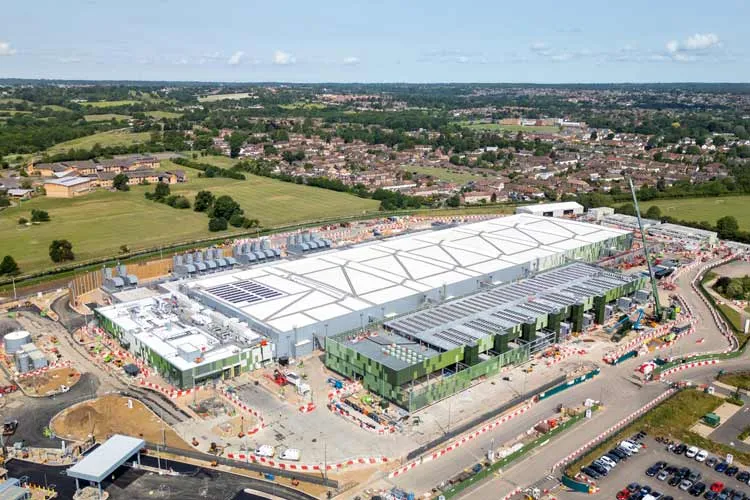
Servers operating in data centers run a large share of today’s digital services behind the scenes; from streaming services and cloud storage to online gaming and AI systems. At first glance, these centers look a lot like crypto-mining farms; both are collections of processing equipment that operate around the clock and in parallel. However, differences in purpose and type of processing, hardware architecture and resource consumption distinguish them from one another.
Purpose; producing cryptocurrency or providing computing services
In proof-of-work cryptocurrency mining, devices continuously perform cryptographic computations to participate in the creation and verification of network blocks. In Bitcoin, this work is mainly based on hashing computations, and the higher the processing power and energy efficiency of a setup, the greater its chance of receiving a reward.
By contrast, data centers have much broader applications. These centers can host cloud services, databases, online applications and AI infrastructure. In the AI sector, GPUs and specialized accelerators are also used to train models and run them.
Hardware similarity, difference in computational needs
GPUs can play an important role in both domains, but memory and interconnect needs are not the same. Crypto-mining farms are typically optimized for a very specialized type of computation, and in Bitcoin mining, dedicated ASIC chips handle the bulk of operations. These chips are designed for a specific mining algorithm and have limited flexibility.
In AI data centers, GPUs and other accelerators must move massive amounts of data between processors and memory. For this reason, memory bandwidth and capacity are very important. Technologies such as high-bandwidth memory or HBM are also used to address data transfer bottlenecks in AI systems.
Power consumption; competing for limited resources
Both types of facilities consume a lot of energy, but the scale of consumption in AI data centers can be much larger. For example, based on the comparison cited in the primary source report, two crypto-mining centers in Sandersville, Georgia collectively consumed power equivalent to the usage of about 110,000 households; whereas two similar data centers in Atlanta had consumption equivalent to about 458,000 households.
Of course, energy consumption is not the only infrastructural cost for these centers. A significant portion of a data center’s electricity is used for cooling equipment, ventilation, fans and power systems. One study also emphasized the growing importance of data center energy use amid the rise of AI and cloud computing.
Cooling; the major challenge of AI data centers
Powerful processing equipment generates a lot of heat, and dissipating this heat is essential to maintain performance and hardware longevity. Modern data centers, especially those equipped with AI accelerators, can rely on complex cooling systems and, in some designs, on water consumption. According to Indiana University data, U.S. data centers consumed about 17.4 billion gallons of water in 2023, and this figure is expected to rise in subsequent years.
By contrast, some crypto-mining farms can use simpler fan-based cooling systems; though these same devices and the continuous operation of the machines can produce significant noise pollution. Even data centers, depending on their design and equipment, can reach high noise levels, and for this reason sound has become an issue for local communities in some projects in this sector.
As a result, although data centers and crypto-mining farms may look from the outside like collections full of servers and processing equipment, their missions and architectures differ. Mining is more focused on performing specialized, repetitive computations for cryptocurrency networks, whereas AI data centers are designed to process, move and store massive volumes of data; a difference that directly affects hardware, memory, networking, power and cooling systems.
According to BGR, this very difference in processing and infrastructural needs means that simply comparing the number of GPUs or servers does not give a complete picture of the differences between the two industries.