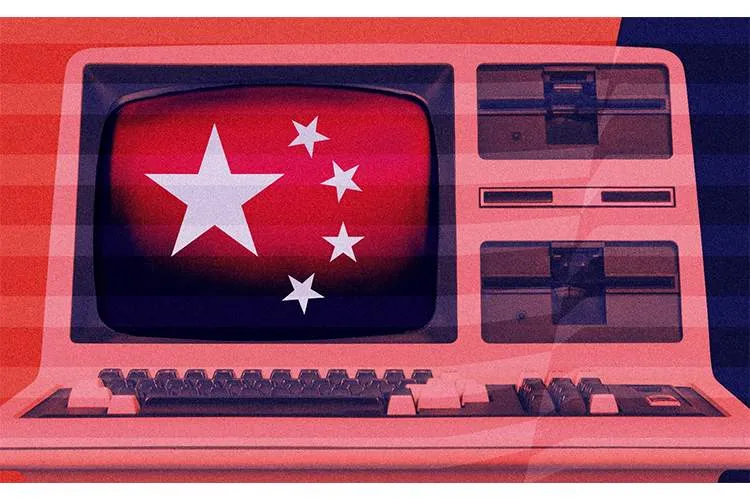
China is striving to gain superiority in the field of artificial intelligence while its approach fundamentally differs from the United States’ strategy.
According to Ittna, while the United States has placed its main focus on developing superior models faster and reaching superintelligence sooner, Chinese authorities’ primary priority is the deep and comprehensive expansion of AI applications within the country; applications that they can monitor and control at all levels of the economy.
Both countries agree on the point that the country that possesses the most powerful AI will hold power, set global standards, and lead economically and militarily in coming decades. But from that point onward, the two countries’ paths diverge.
China’s fifteenth five-year plan
The fifteenth five-year plan document of China, published in March, clearly shows the country’s strategy. The term artificial intelligence is repeated 52 times in this document, five times more than half a decade ago, and an entire chapter is devoted to processing power.
China’s goal is to integrate AI into 90 percent of the country’s economy by 2030; a program for which the United States has no equivalent.
Notably, China’s ruling party is not greatly concerned about administrative and office loss or the risk of AI rebelling against humanity. The main worry of Chinese leaders is that AI might one day be used against the governing system itself.
Chen Yixin, head of China’s intelligence apparatus, has in recent weeks publicly warned about AI’s ability to launch public opinion wars and a “cognitive war against China,” describing it as a threat to “political security, institutional security, and ideological security.”
China’s weaknesses
China’s AI strategy is in fact a response to serious domestic challenges that the country typically mentions less in its international propaganda:
- An aging population: China’s population has declined for the fourth consecutive year and the country has nearly as many citizens over 60 as the entire population of the United States; a factor that partly explains China’s intense focus on robotics.
- High youth unemployment: China’s youth unemployment rate has now reached 19 percent, which is roughly twice that of the United States.
- Poverty in non-urban areas: the five-year housing crisis and falling housing prices have also put pressure on the primary assets of many households.
- Weakness in chip production: Nvidia’s products still outperform Chinese chips and Huawei, which is trying to play the role of China’s Nvidia, remains behind despite government support.
- Dependence on exports: China’s domestic economy, despite success in exporting cheap cars, components, and technology, faces weak domestic demand.
China’s strengths
Conversely, China has overtaken the United States in providing the “physical inputs” needed for AI scalability - including energy, minerals, robots, and low-cost widely used models:
- Energy: According to BloombergNEF estimates, China will add roughly six times more power generation capacity than the United States over the next five years.
- Critical minerals: The International Energy Agency finds that among 20 key minerals for building AI hardware, China leads in refining almost all of them - except one - and controls the export of half of them.
- Industrial robots: More than half of the industrial robots installed worldwide in 2024 went to China.
Cheap open-source models: Five of the six popular models on the OpenRouter platform, the leading AI marketplace, belong to Chinese companies.
- Land and air autonomy: China leads in autonomous vehicles and drones; DJI alone holds more than 70 percent of the global drone market.
Technology gap
According to Axios, China leads the world in building low-cost open-source models, but is about six months behind the United States in advanced leading models, and that with a fraction of U.S. investment.
Models such as Kimi K3 from Moonshot, Qwen3.8-Max from Alibaba, GLM-5.3 from Zhipo (Z.ai) and DeepSeek V4 are among China’s most important models, with the previous version of GLM being only one point behind Anthropic’s Claude Opus 4.8 in some programming tests, and that with less than one-fifth of the cost.
U.S. officials and companies have for some time accused Chinese firms of “distillation” of models; that is, sending millions of covert queries to U.S. models and training their own models based on the responses.
Washington, although it has threatened sanctions and blacklisting, has not yet taken practical action.
Public enthusiasm; a marked difference with the U.S.
Statistics show that 80 percent of Chinese people use AI weekly, while this proportion in the United States is 54 percent. Also, 84 percent of Chinese feel excited about AI (the highest figure in the world), while this number in the United States is only 38 percent.
Public trust in AI in China is also reported at 87 percent, compared to only 32 percent in the United States.
However, some analysts warn that this apparent optimism may be hiding growing concerns about job loss.