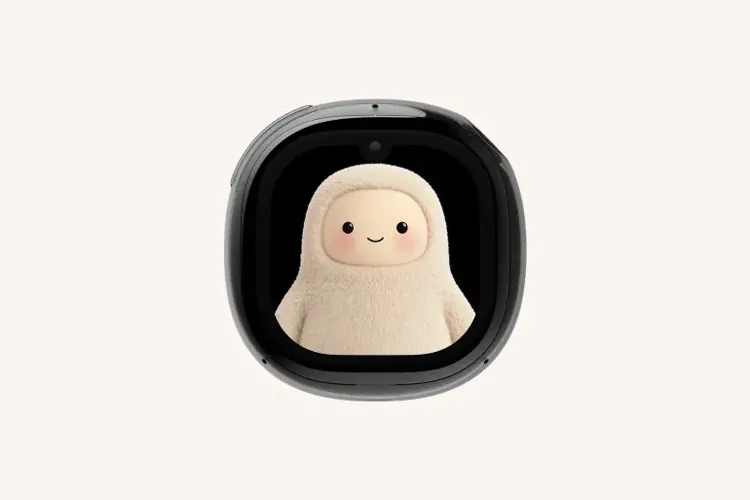
Meta unveiled Muse Charm at its annual hardware conference; a small device roughly the size of an AirPod case that combines a touch display, 5G connectivity, and AI capabilities in a portable form.
The product was introduced as major tech companies seek the next generation of user interfaces. In this approach, AI is not meant to operate only inside the smartphone and its apps, but can reside in smaller, wearable devices and directly handle some tasks that today depend on the phone’s screen.
Muse Charm matters to Meta for this reason. The company is trying to build devices so users won’t have to pull out their phone, unlock it, find the desired app, and go through multiple steps to perform simple everyday activities.
A small device with 5G connectivity and a touch display
Muse Charm is about the size of an Apple AirPod case and has an approximately two-inch touch display. The device also features built-in 5G connectivity and can be carried or attached to a keyring.
Meta has not yet announced the final price of Muse Charm, but intends to ship it in the December holiday season.
The device’s design indicates Muse Charm is not intended to replace the smartphone in all uses. Instead, its goal is to handle short, quick tasks-tasks that do not require a large display, a keyboard, or running a full app.
A user can request information from the device via voice command or ask it to perform a specific task. The small display is meant for cases where visual information presentation is necessary.
As a result, the main idea of Muse Charm is to reduce the number of steps a user must take to perform a simple activity, not to fit all smartphone capabilities into a very small device.
Muse moves from answering to doing
The more important part of the story is not the hardware itself, but the AI behind it.
Muse Charm is directly connected to Meta’s Muse AI assistant. The company is trying to turn Muse from a simple conversational assistant into a kind of personal agent that, in addition to answering questions, can perform specific tasks for the user.
Meta said at the Connect conference that Muse’s capabilities are expanding and the assistant can connect to a wider range of services and stores. Tasks such as shopping, booking appointments, and managing some processes via voice command are part of this trajectory.
One notable capability Meta envisages for Muse is having a dedicated email address. This feature could allow Muse to act more independently in some processes or to communicate with services and people to carry out specific tasks.
This change creates an important distinction between traditional assistants and the new generation of AI agents. Old assistants mainly responded to user queries; AI agents are intended to take on part of the steps required to complete a task.
When the glasses look at what the user is looking at
Meta does not intend to limit Muse to Muse Charm. The company is integrating the assistant into its smart glasses as well.
In this scenario, the AI can use not only the user’s voice but also information about the surrounding environment; for example, the user might look at a product on a shelf and ask about it, or ask the glasses to read a long piece of text and highlight the important information.
Such a capability represents a significant change in how humans interact with AI. On a smartphone, the user typically has to first search for the information on the screen and then present it to the assistant. But in devices equipped with cameras and sensors, the surrounding environment itself can become part of the AI input.
This is the path Meta hopes will ultimately shift interaction with digital services from the phone screen to the user’s real environment.
Why is a separate device necessary at all?
At first glance, having a separate device to perform AI tasks may seem odd. Today’s phones have powerful hardware and constant internet connectivity and can run AI assistants.
However, Meta is focusing on a different scenario: small, quick tasks without the need for a large display.
For example, asking a question, receiving brief information, making a simple request, or initiating an interaction can be done via voice command. In such cases, taking the phone out of a pocket and opening an app may be an extra step.
Muse Charm actually aims to remove that gap.
Of course, it is unclear whether this idea can become a widespread usage pattern. The success of such a product will depend on factors like battery life, response speed, AI accuracy, price, privacy, and users’ willingness to carry another device.
Meta introduced more than one device
Muse Charm is part of a larger set of new Meta products introduced at the company’s hardware conference.
At the same event, Meta unveiled Ray-Ban Meta Audio; glasses that, unlike some other smart models, focus mainly on audio and AI and do not have a camera. These glasses are designed for playing music and podcasts, making calls, and interacting with a voice assistant, and Meta said their battery life is up to 12 hours. The base price of this product is $349.
The third-generation Ray-Ban Meta was also introduced with a 12-megapixel camera and the ability to record video at 3K resolution, and its base price was announced as $449.
Meta also unveiled a new generation of its virtual reality glasses priced at $1,299. The product is expected to ship in spring 2027. These glasses are close in size to regular sunglasses and weigh no more than 100 grams; a feature Meta cites as one of this product’s differentiators.
Taken together, these products show that Meta’s hardware strategy is not limited to one category of devices and the company is testing multiple paths to replace or reduce the phone’s role in daily interactions.
Privacy; the big challenge for always-present devices
But the closer AI gets to the user, the more serious privacy concerns become.
A device that is often next to the user and listens to voice commands can handle very personal information. This concern is even greater for smart glasses; because the device may perceive or record the environment and other people in addition to the user.
Meta is focusing on a technology called private compute for some of these concerns. In this architecture, some AI tasks are processed in the cloud within confidential computing environments; environments designed to limit the service provider’s access to user data.
Use cases mentioned for this architecture include voice transcription, text search, and retrieval of information related to past interactions.
However, using such technologies still raises questions about how information is recorded, consent of people present in the environment, data retention periods, and how the data are used. As devices’ ability to understand the surrounding environment increases, answering these questions will become more important.
Has the post-phone era really begun?
According to Reuters, it is unclear which of the new AI device formats will ultimately become widely used products. Muse Charm still needs to be tested in the real market to determine whether users are willing to carry a separate device to perform simple tasks or prefer to do those tasks with their smartphone.
However, Meta’s direction is clear: the company wants to take AI out of apps and make it a permanent part of the user’s living environment.
In such a model, the smartphone can still be used for more complex activities, but everyday short tasks are delegated to devices that are always accessible; from a small gadget like Muse Charm to smart glasses.
If this interaction model succeeds, the main change will not be the device size but the interface between humans and technology: instead of the user adapting to screens and apps, AI will try to bring digital services directly closer to the user’s environment and daily life.
Muse Charm sits right at that point; a small device that may not by itself displace the smartphone, but shows that the race to build the next generation of personal AI tools is being pursued more seriously than before.