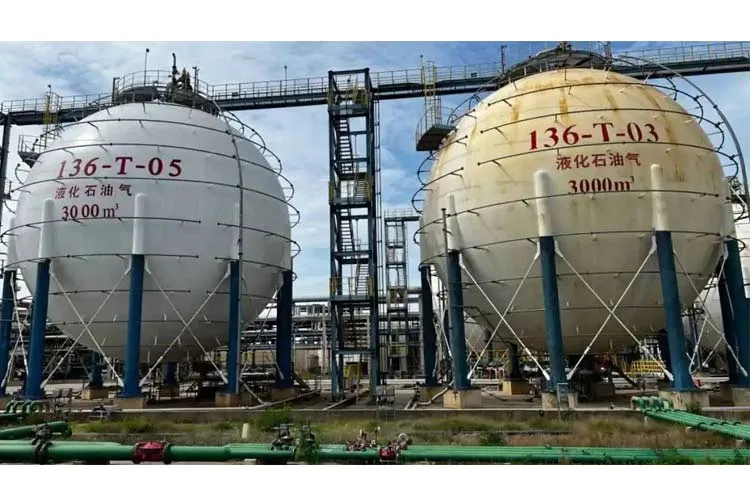
China has begun mass production of a type of radiative cooling coating that can significantly lower the temperature of surfaces exposed to direct sunlight without using electricity or cooling fluids. This technology, tested for the first time at a petrochemical facility in southern China, could provide a way to reduce water and energy consumption in hot regions and mitigate the effects of heat waves.
The coating was tested at a petrochemical center in Hainan province on large spherical tanks containing liquefied gas. The tanks were exposed to direct sunlight and before using this technology, sprinkler systems were used to control their temperature; a method that required a considerable volume of water.
The new coating works on the principle of radiative cooling. In this method, the surface must reflect as much of the sun’s radiative energy as possible while at the same time transfer absorbed heat as infrared radiation to the surrounding environment and ultimately out into space. In this way, cooling occurs without the need for compressors, electricity, or continuous water flow.
In one field test, when the air temperature was about 30 degrees Celsius, using this coating reduced the surface temperature of the tank by about 25 degrees Celsius. The internal temperature of the tank also dropped by about 7 degrees Celsius. This difference indicates that a reduction in surface temperature does not necessarily translate equally to the interior of a structure or tank, but it can still reduce the thermal load on equipment.
Reducing water consumption is one of the most important potential advantages of this technology. According to estimates presented in the project report, achieving a similar level of cooling with sprinklers could require about 35 tons of water per tank per day. Therefore, using a passive coating could be particularly important in areas facing both extreme heat and water scarcity.
The structure of this coating is made from a combination of mineral fillers and polymer resins. Its design is intended to provide two features simultaneously: reflect a large amount of solar radiation and effectively emit surface heat as infrared radiation.
One interesting feature of this technology is that researchers were inspired by microscale structures found in human skin. Using a special surface structure, researchers sought to preserve the coating’s thermal performance at very small thickness. As a result, the coating’s thickness was reduced from about 500 micrometers to 100 micrometers, and according to the development team, both solar reflectance and infrared thermal emission reached about 97 percent.
The coating’s durability was also examined in field tests. In an 180-day test it withstood about 40,000 abrasion cycles without peeling or forming bubbles on the surface. Developers estimate its operational lifetime at around 15 years; however, its actual durability in different conditions and environments may depend on environmental factors and the type of surface used.
The technology was developed by Harbin Institute of Technology in collaboration with China Construction Eco-Development, and has now moved beyond the laboratory stage into commercial production. The announced annual production capacity for this coating is about 600,000 tons; a capacity that indicates the developers planned for wide industrial application from the outset.
According to the South China Morning Post, if deployment expands this coating need not be limited to industrial facilities. Residential and commercial buildings, public infrastructure and other structures exposed to intense sunlight could also benefit from this technology. One potential application is reducing buildings’ thermal load and consequently reducing the need for continuous use of air-conditioning systems in hot regions.
The performance of this coating also depends on the so-called "atmospheric window." In the wavelength range of about 8 to 13 micrometers, part of the infrared radiation can pass through the atmosphere and transfer heat from Earth’s surface to outer space. The new coating uses effective emission in this range to take advantage of this natural atmospheric feature to dissipate heat.
The importance of this technology lies in that, unlike conventional cooling systems, it does not require continuous energy or water consumption to produce a cooling effect. If its performance and durability are confirmed at large scales and under various climatic conditions, such coatings could become one of the complementary tools for managing urban heat, reducing industrial water use, and combating temperature increases caused by heat waves.