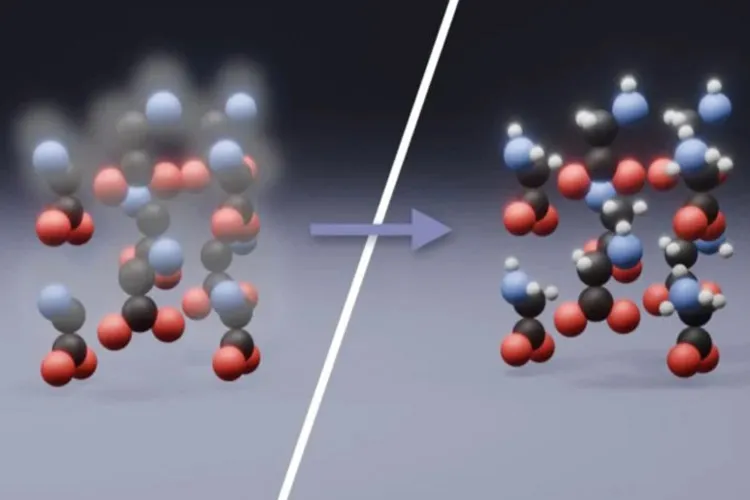
A crystal structure may look nearly complete, but still be unusable for computer simulations because some of its atom sites are empty.
Hydrogen is a frequent source of these gaps, and according to Etnā citing SciTechDaily, researchers have built a model that predicts where those hidden atoms belong by adapting an artificial intelligence technique used for image restoration.
The method was developed by a group led by Giovanni Pizzi of the Centre for Scientific, Theoretical and Data Computing at the Paul Scherrer Institute, in collaboration with researchers from the Universities of Parma and Modena in Italy.
Described in the journal npj Computational Materials, the approach uses computer vision, in which AI recognizes and interprets visual information. Specialized AI systems already assist materials research, but the new method focuses on filling missing sites in experimentally known structures.
Hydrogen causes a persistent problem. Although this element is often part of the crystal lattice, standard X-ray diffraction methods used to determine atomic arrangements do not easily detect it. As a result, crystal visualizations may place hydrogen atoms incorrectly or omit them entirely.
Timo Rents (left) and Giovanni Pizzi trained an AI system to find missing hydrogen atom positions in crystal structures.
Simulations require accurate atomic coordinates to predict properties such as electrical and thermal conductivity. Giovanni Pizzi says: "If information about hydrogen atoms is missing, that's a problem. Often, we cannot use several thousand potentially interesting materials for our simulations precisely for that reason."
The researchers' solution was inspired by diffusion models used in computer vision. When these systems reconstruct a missing part of an image, the process is called "inpainting."
Older models covered the whole image with random information, but modern approaches concentrate stronger noise in the unknown region and affect the visible parts much less.
This selective process gives the model a reliable starting point and can use surrounding information to infer what belongs in the gap. Although selective inpainting is well established in computer vision, it was not previously available for reconstructing missing atomic positions.
Pizzi's group solved this by developing OxtalPoint, an open-source model adapted from Microsoft's Mixture (Mixture? translator note: keep as in source) translator.
Timo Rents, a PhD student in Pizzi's group, explains: "This method combines the advantages of modern computer vision and crystal reconstruction: noise is added only to unknown positions inside the crystal, and known positions remain largely unchanged during the process."
Because OxtalPoint preserves most of the existing structure, it can use known atoms as guides during reconstruction. Rents adds: "By stepwise reconstruction, OxtalPoint can orient itself to the existing crystal from the very beginning, which increases success rates and saves computational power."
The researchers tested OxtalPoint by taking crystal structures with known hydrogen positions, removing those coordinates, and asking the model to reconstruct them.
In 87 percent of tests, OxtalPoint recovered the previous arrangement. In another ten percent, it produced configurations that were energetically more stable than the recorded structures.
Rents said: "Overall, this means a 97 percent success rate for OxtalPoint." The model can now be used to recover missing hydrogen coordinates in materials databases. Pizzi and his colleagues also used the method to identify database errors.
It is worth noting that the potential application of this new finding goes beyond hydrogen, and the same approach can reconstruct lithium and sodium positions as well - the two elements important in the search for new battery materials.