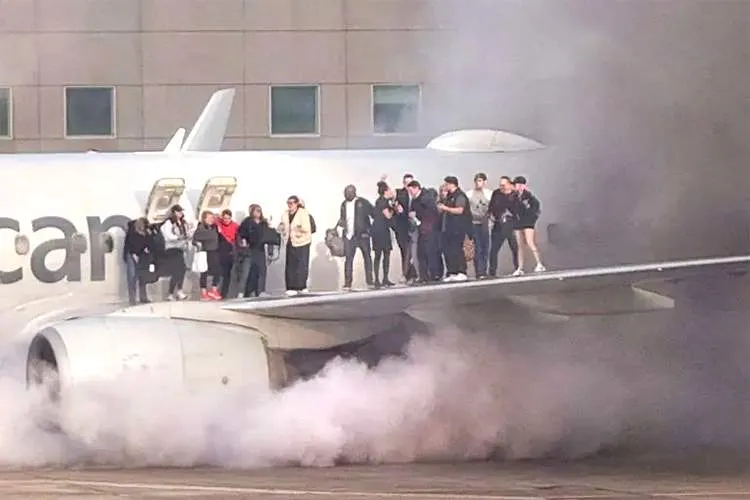
A laptop catching fire on a plane in flight caused several passengers to suffer burns.
The incident occurred on Friday, 21 August 2026, on an American Airlines flight traveling from Atlanta to Texas with 133 people on board.
According to ITNA, in the final stage of the flight, one passenger’s laptop began to emit smoke and then caught fire. The smoke was intense enough that passengers noticed the incident and an emergency situation developed in the cabin.
Immediately, the pilot informed air traffic control that a fire had broken out in the rear section of the aircraft and that flight attendants were attempting to extinguish it. The pilot also announced that four to five passengers had been burned as a result of the laptop.
One passenger who was two rows away from the scene told CBS News that a lot of smoke had spread throughout the cabin and one of the passengers went to help at the scene.
According to him, at least some of the people who attempted to control the laptop sustained burns to their hands.
Eventually the crew were able to place the laptop in a special bag for containing fires in electronic devices and prevent the fire from spreading.
After the plane landed at the airport and while emergency responders were waiting on site, at least one passenger received treatment after landing and was then discharged.
Why can a laptop battery catch fire?
Batteries used in devices such as laptops, smartphones, and power banks are usually lithium-ion. These batteries store a large amount of energy in a relatively small volume, but under certain conditions they can experience a phenomenon known as thermal runaway.
In this state, a rise in temperature causes further internal reactions and more heat generation, entering a cycle that feeds on itself, which can ultimately lead to a severe fire.
The FAA has warned that thermal runaway can result from factors such as physical damage to the battery, excessive heat, contact with water, overcharging, improper packaging, or even manufacturing defects.
Therefore, this risk is not limited to laptops; smartphones, tablets, power banks, and other devices equipped with lithium-ion batteries can also face this problem under certain conditions.
Is carrying a laptop on a plane dangerous?
It should be noted that the occurrence of such incidents does not necessarily mean that carrying an ordinary laptop on a plane is dangerous, because lithium-ion batteries, when intact and used correctly, are generally safe and millions of passengers carry their electronic devices on planes every day without issue.
The significance of this type of incident lies more in the fact that an internal defect, physical damage, or an abnormal temperature rise can, in rare cases, lead to a serious situation.
For this reason, passengers should refrain from carrying devices with damaged or swollen batteries and, if they observe symptoms such as unusual heating, a burning smell, deformation, or smoke, they should immediately inform the flight crew.
But a fire occurring inside an aircraft is more serious than a similar incident on the ground; the cabin space is confined and smoke and fire can affect many passengers in a short time.
U.S. aviation regulations also set limits on the capacity of portable lithium batteries on flights. Under these regulations, devices with batteries and spare batteries must be carried in the passenger cabin, not in checked luggage, because in the event of smoke or fire the crew in the cabin can respond more quickly.
This is not the first incident of this type this year. In February, an Alaska Airlines flight had to return to the airport after a passenger’s power bank overheated and caught fire.
According to FAA data, as of August 2026 at least 56 incidents related to lithium batteries, including smoke, fire, or overheating, have been reported on passenger aircraft.