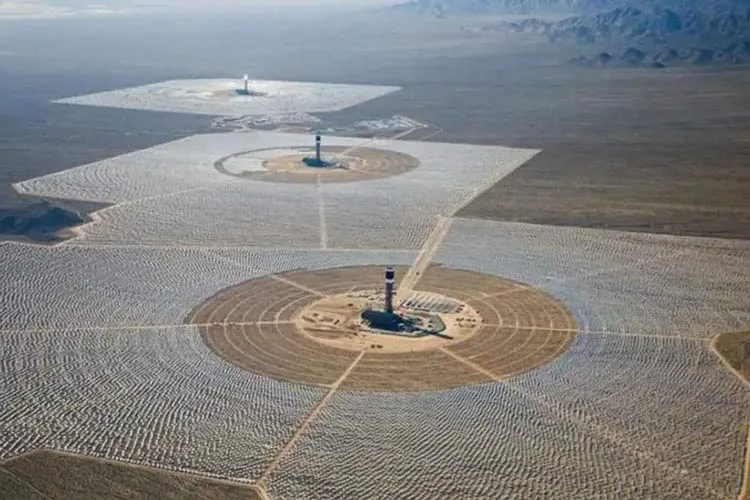
From high above, the Ivanpah concentrated solar power plant in the Mojave Desert of California resembles a vast sea of gleaming mirrors; a striking sight that conceals significant environmental and operational challenges.
This plant uses thousands of giant mirrors called heliostats to collect sunlight and direct it toward receivers atop tall towers. Unlike solar plants that rely on photovoltaic panels, this technology uses the heat from concentrated sunlight to generate electricity.
The heliostats follow the sun’s path throughout the day and continuously reflect light toward receivers mounted on top of the towers. This extensive concentration of light creates very high temperatures around the receiving towers; some studies have shown that temperatures in certain spots can exceed 1,000 degrees Fahrenheit, equivalent to about 538 degrees Celsius.
Birds trapped in the path of light
One unforeseen consequence of this technology was its danger to birds flying around the plant. Some birds could inadvertently enter the concentrated sunbeams and be exposed to intense heat that could cause lethal injuries.
Bird deaths around the complex have been recorded, raising serious concerns about the impact of concentrated solar power plants on wildlife. Estimates indicate that thousands of birds may die annually near these facilities, and in one study that number was reported to be around 6,000 birds per year.
Glare that troubled pilots
However, birds were not the only potential victims of this technology. Under certain conditions, reflections from thousands of mirrors could produce blinding glare that extended into the airspace around the plant.
Some pilots have reported seeing intense and sudden brightnesses; a phenomenon that can temporarily affect visual ability. Studies have also examined the possibility of creating "afterimages" in the field of view after exposure to very intense light.
Of course, this does not mean permanent blindness for pilots, but sudden and intense glare can be an operational hazard, especially in low-altitude flights where clear vision is particularly important.
The other side of clean energy
The experience of the Ivanpah plant highlights a less-discussed aspect of the transition to renewable energy. Clean energy technologies can also have unforeseen environmental and operational consequences; issues that make site selection and facility design critical.
Accordingly, researchers and experts have examined various measures to reduce blinding glare and limit potential risks to birds and aircraft. Such measures include adjusting mirror positions under certain conditions and strengthening monitoring of the airspace around the plant.
Ivanpah now stands as a notable example of the challenges facing the future of clean energy; a future whose success will not only depend on the amount of electricity produced, but also on how energy is produced and how unwanted effects on humans and the environment are mitigated.