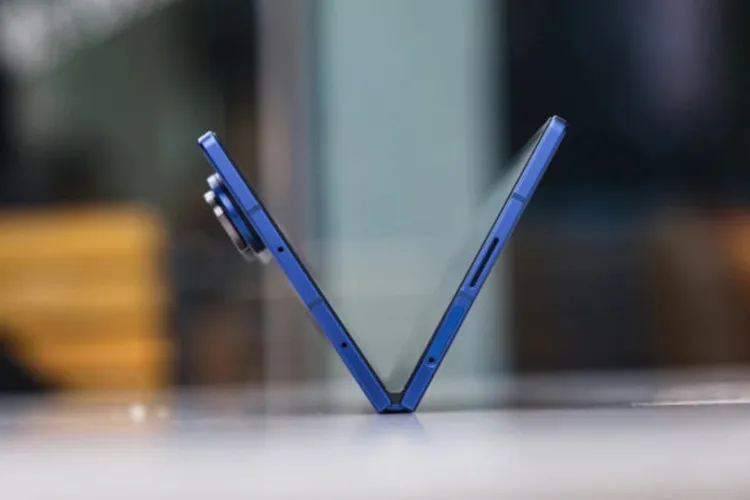
Although seven years have passed since the launch of Samsung's first foldable phone, the Galaxy Fold, and this category of smartphones has made remarkable progress in displays and design during that time, they still struggle with one of their fundamental faults; a fault that experts say must be fixed before these phones become widespread among ordinary users.
A problem beyond the screen crease
Most common criticisms of foldable phones usually focus on the fragility or the central crease of the display; a fault that is still visible in many models. However, there is another annoying problem that has received less attention: how much these phones wobble when laid flat on various surfaces. The root of this problem should be sought in the design of the camera module.
Today it is almost impossible to find a smartphone that does not have a camera bump on the back; an issue for which even Apple has coined a specific name, although that term has not become widely used among general users.
Why do foldable phones wobble more than others?
This problem is more pronounced in foldable phones due to manufacturers' efforts to reduce their thickness. The main goal of this design was to achieve an appearance similar to ordinary smartphones when folded, but since key components such as camera sensors still require considerable internal space, the camera bump has been used as a solution to provide that space. Although this solution seems technically clever, in practice it causes the phone to wobble significantly when placed on flat surfaces.
A clear example of this problem can be seen in the Galaxy Z Fold 8; a phone whose camera module not only has a noticeable protrusion but is also positioned vertically on the back. This has led many users on the social network Reddit to complain about how much this phone wobbles. Some users have even opened their phone bodies to remove the rear cameras completely; an action that, although not recommended, reflects the high level of user dissatisfaction with this design.
Is there a solution to this problem?
Given the trend of decreasing phone thickness and the continuous advancement of camera technology that requires larger sensors, it seems this challenge will persist in the near future. One possible solution is a return to thicker designs with a flat back; an approach common in earlier generations of phones. However, the likelihood of manufacturers returning to this design is very low, and currently, using thick cases for foldable phones may be the only practical solution for users.
Other challenges facing foldable phones
Using foldable phones, despite their particular attractions such as combining the capabilities of a small tablet with pocketability, still comes with significant drawbacks. Samsung's latest products in this area have attracted wide attention, especially given rumors about Apple's unveiling of its first foldable iPhone next month, which could further increase public interest in this category of phones.
However, the crease in the middle of the display remains; although companies have managed to make this flaw less noticeable, after several months of use and repeated opening and closing, the fault will still be visible. Another problem relates to software, especially on Android; because many apps are still not properly adapted to these phones' large, tablet-like displays. For example, apps like TikTok still look awkward on the wide and short screen of the Galaxy Z Fold 8; an area where Apple may gain an advantage due to iOS apps adapting more quickly to new devices and features.
On the other hand, the high price of these phones compared to regular models is another major barrier; while they do not always use the most advanced hardware available on the market. For instance, even the Galaxy Z Fold 8 Ultra, priced at $2,100, lacks features such as five-times optical zoom and sixty-watt fast charging compared to the Galaxy S26 Ultra. It is also said that Apple's rumored foldable iPhone will lack a telephoto lens and Face ID; features that have become standard in Apple's Pro iPhone models.
It seems that for now, users are still forced to choose between a foldable display and a complete set of standard smartphone features.