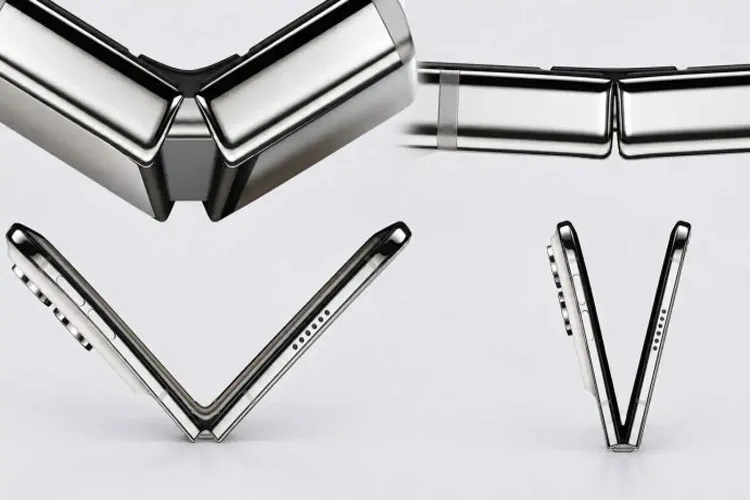
Apple, during the keynote on Wednesday, unveiled its first foldable phone called the iPhone Duo and provided interesting details about the device's most complex part, the hinge. The iPhone Duo hinge consists of more than 100 parts and Apple uses part-matching algorithms, laser scanning, and 3D printing to achieve its precise operation.
The hinge in foldable phones is one of the most important design components. This part not only controls the opening and closing of the device, but is also responsible for supporting the middle of the display during movement and keeping the screen aligned when open. To achieve this behavior, Apple uses a variable torque curve and a lattice of magnets in the hinge structure.
Carbon fiber sheets are used in the hinge structure and its covers are made of 100 percent recycled titanium. These covers are produced using 3D printing and then receive their final surface through fine bead finishing.
But the complexity of making the hinge is not limited to the number of its parts. In the manufacturing process, Apple uses an algorithm to match each hinge to the appropriate frame. After assembly, a laser system scans the lines of each unit to identify very subtle differences in their structure.
In the next step, a 3D printer can print up to 25 very thin layers of photopolymer to correct remaining waves and irregularities under the display.
Apple does not present this process as AI-based technology and calls it a matching algorithm and laser scanning. This explanation indicates that we are dealing with a kind of industrial calibration process; a process in which each part is measured, compared with other parts, and then paired with the most suitable components so that remaining discrepancies are also corrected.
Multilayer structure to protect the foldable display
The hinge is not the only complex part of the iPhone Duo and the display itself is surrounded by a set of protective and reinforcing layers. In this structure, there is a polymer layer with a nano texture that Apple says is up to 40 percent harder than the samples used in other parts.
Alongside this layer, an anti-scratch coating, high-strength glass at the top and bottom of the OLED display, and flexible adhesives are used. These adhesives allow the various layers to move over each other when the device is opened and closed. Titanium sheets are also placed at the back of this structure.
Apple also uses reinforcing supports and ceramic fiber inserts in areas where the antennas intersect with the device frame. The iPhone Duo also has an IP68 rating; meaning the device can withstand up to 30 minutes in water at a maximum depth of 6 meters and is resistant to dust.
3D printing for every iPhone Duo
One notable point in the iPhone Duo manufacturing process is the use of 3D printing for each device. Instead of relying solely on very tight production tolerances and reinforcing sheets under the display, Apple measures each device individually and then produces a compensating layer tailored to that device.
This approach allows Apple to correct very small discrepancies created during assembly on an individual basis; an issue that is highly important in a foldable phone and especially in the sensitive area under the display.
Apple has previously used 3D printing in some of its products; including the titanium USB-C port of the iPhone Air and the titanium case of the Apple Watch Ultra 3.
However, the approach used in the hinge frame of the iPhone Duo is a different step. 3D-printing a separate compensating layer for each device and placing it under the display, in a consumer product of this scale, is an unprecedented move. Of course, the effectiveness and longevity of this method in the long term still need to be determined in real user use.