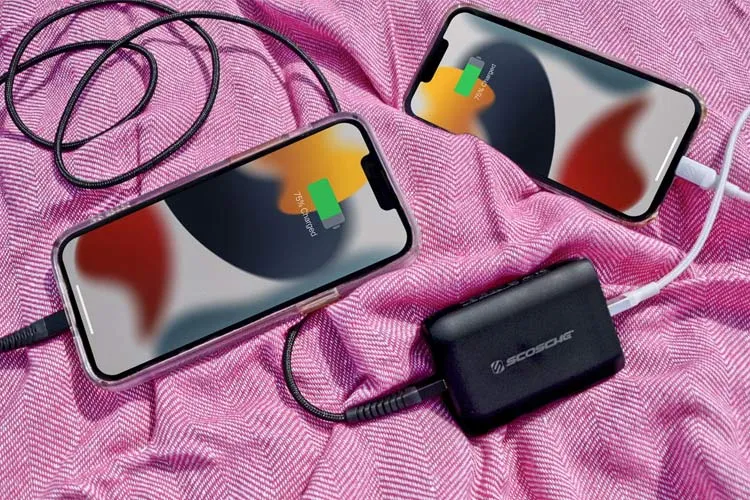
Power banks have become one of the most useful accessories for users who don’t have access to an electrical outlet during the day. Modern models, in addition to various capacities, offer features such as fast charging, wireless charging, built-in cables, and even battery status displays. However, even the best power banks eventually face reduced battery capacity.
One of the most important metrics for assessing a power bank’s lifespan is the “charge cycle.” A full cycle is counted when a total equivalent of 100 percent of the battery’s capacity has been used; therefore, this does not necessarily mean fully draining the battery from 100 to 0 percent in one go. For example, if today 50 percent of the battery capacity is used and then recharged, and the next day another 50 percent is used, the total of those two usages counts as one full cycle.
According to information published by Anker, many power banks go through about 300 to 500 full charge cycles. In typical use, this amount can result in several years of useful life; however, the exact duration depends on the number of uses, the quality of the battery cells, and storage conditions. The company has also stated in another guide that the typical life of common power banks is about 2 to 3 years.
Of course, not all power banks follow the same pattern. For example, Belkin has stated for some new models equipped with BoostSolid technology that the battery can still retain more than 80 percent of its initial capacity after more than 1,000 charge cycles. This figure shows that battery cell technology can make a significant difference in a power bank’s lifespan.
Why is heat important for a power bank’s lifespan?
High temperature is one of the important factors in the degradation of lithium-ion batteries. Wireless charging also typically involves more energy loss and heat generation compared to wired charging due to the way energy is transferred between the charger and device coils. Therefore, continuous use of wireless charging can create less favorable thermal conditions for the battery; however, the extent of its impact depends on the design, thermal management system, and product quality, and one cannot assign a uniformly shorter lifespan to all wireless power banks.
In fact, more important than whether a power bank is wired or wireless is the amount of heat produced during use and charging. Storing the battery in very hot environments and exposing it to extreme temperatures can accelerate the capacity degradation process.
End of the charge cycle does not mean sudden death of the power bank
Reaching the announced range of cycles does not mean the device will suddenly stop working. Usually the battery capacity decreases gradually and near the end of its useful life it may retain only about 60 to 80 percent of its initial capacity. In such conditions, a power bank that once could charge a phone multiple times may only provide one charge or even less.
Usage patterns also matter greatly. A power bank that undergoes heavy cycles every day will reach the wear range faster; in contrast, a model used only during travel or emergencies may remain usable for more years. However, low usage also does not mean the battery is immune to degradation, and long-term storage in a fully empty state may not be good for the battery.
More important than capacity loss is paying attention to warning signs. Swelling of the casing, unusual heating, strange odors, cracking, or physical damage can indicate a battery problem. In such cases the power bank should not continue to be used and it is better to set it aside for inspection or safe disposal.
In conclusion, for a typical power bank, one cannot set a fixed number as its lifespan; but the number of charge cycles, cell quality, usage pattern, and heat management are the four main factors determining its life. Proper care can allow the battery to maintain acceptable performance for several years, while heavy use and constant exposure to high heat can reduce its capacity more quickly.