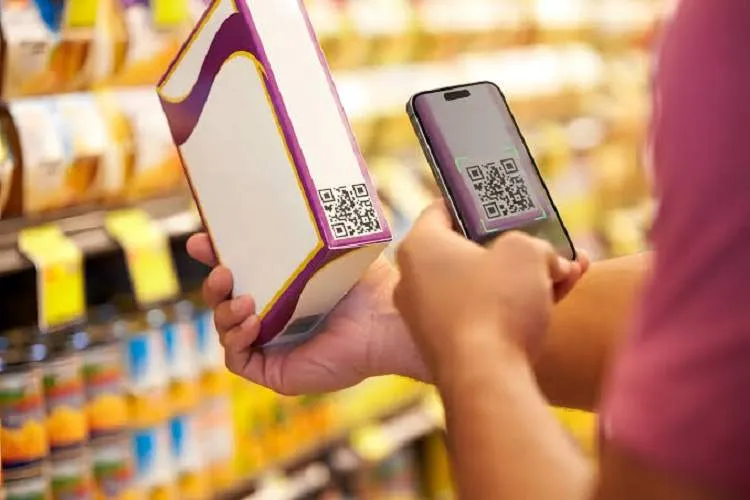
The QR code (QR Code) was invented in 1994 by Denso, a supplier to Toyota, to speed up automobile production lines.
According to ITNA quoting TechSpot, the main problem was that traditional barcodes stored limited information and factory workers had to scan several barcodes for each parts box. A team led by Masahiro Hara, inspired by the Go game board, arrived at a two-dimensional pattern of black-and-white squares.
QR stands for "Quick Response." Unlike one-dimensional barcodes, QR codes can be scanned in any direction and store a much larger volume of information. Each code is composed of small squares called modules and, in addition to data, contains areas for position detection, size adjustment, error correction, and code structure identification. Three large squares in the corners help the camera quickly determine the code's orientation.
One important feature of QR is error correction. Reed–Solomon technology allows the code to remain readable even if part of the image is damaged. There are four levels of error correction that can recover about 7, 15, 25, or 30 percent of the data. This capability also makes it possible to place a logo in the center of some QR codes.
QR codes are offered in 40 versions with different sizes. The smallest version has a 21 by 21 grid and version 40 can, under suitable conditions, store up to 7,089 digits or 4,296 alphanumeric characters. These codes are used for various purposes such as opening links, connecting to Wi‑Fi, transferring contact information, sending messages, activating eSIMs, and pairing devices.
QR codes now also play an important role in mobile payments. In countries such as China, India, and Brazil, the technology has become one of the main payment methods. In India, the Unified Payments Interface (UPI) instant payment network recorded a record 24.5 billion transactions in August 2026. In retail, the Sunrise 2027 scheme is also seeking to expand the use of two-dimensional barcodes at checkout.
But increased use of QR has also raised security risks. Quishing, a type of phishing based on QR codes, directs users to fake websites. Because a QR code appears like an image and its destination cannot be inspected like a normal link before clicking, attackers can use it to steal login credentials, banking information, or even gain access to accounts. Therefore, before opening the destination of an unknown QR, one should check the displayed address and exercise extra caution with codes related to payments or account logins.
In the future, QR's applications will likely broaden further; from digital passports and electric vehicle battery passports to payments and product labeling. Thus, the technology that was built to solve a simple industrial problem has now become one of the most important bridges between the physical and digital worlds.