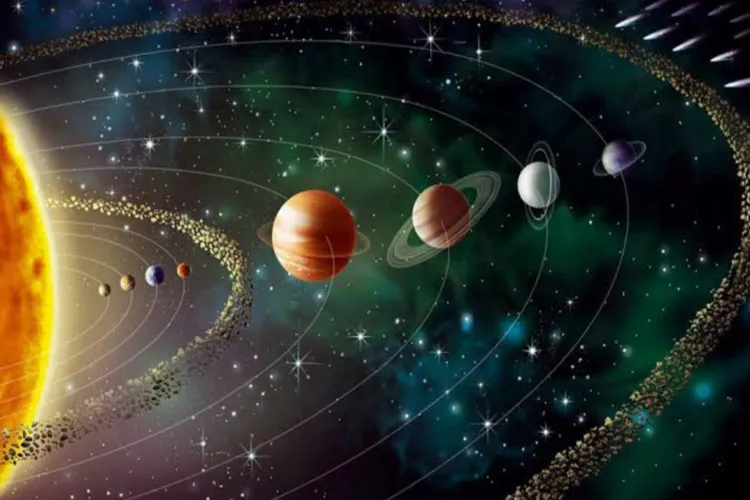
The fate of the Solar System may be much shorter than earlier models predicted. According to a new study, drastic changes in how the Sun loses mass could destabilize the orbits of the outer planets and ultimately cause the Solar System to fall apart about a billion times sooner than previous estimates.
The Sun will lose its nuclear fuel and enter the final stages of its life in about 8 billion years. The star will first become a red giant and then, after losing a significant portion of its mass, turn into a smaller, cooler white dwarf. The remaining white dwarf is expected to contain only a little more than half of the Sun's current mass.
An old assumption about the death of the Solar System
Previous studies of the fate of the outer planets, including Jupiter and Saturn, were largely based on the assumption that the Sun loses mass fairly uniformly and gradually. Under such a model, after the Sun becomes a white dwarf, the orbits of the outer planets could remain stable for nearly a quintillion years.
But the new research shows this assumption may not present an accurate picture of the Solar System's future.
The study, conducted by researchers at the California Institute of Technology (Caltech) and published in the Astrophysical Journal Letters, suggests the Sun may lose mass not merely as a smooth, continuous flow but in eruptions and sudden ejections.
These eruptions can occur at different times and directions and each can impart a small gravitational jolt to the planets. Perhaps each event alone would not have a noticeable effect, but over time, the accumulation of these changes could severely destabilize the orbits of the outer planets.
Jupiter and Saturn may be ejected from the Solar System
According to the new model, these small but frequent changes could eventually drive Jupiter, Saturn, and other distant objects out of their current orbits. In such circumstances, planets might enter highly elongated orbits or even be ejected from the Solar System due to gravitational interactions.
Based on the researchers' simulations, the Solar System after the Sun becomes a white dwarf may last only about a billion years; a figure much shorter compared to the previous estimate of nearly a quintillion years.
However, even that billion years will not occur in all scenarios. In about 40 percent of the simulations run by the research team, the planets became disturbed or were ejected during the red giant phase before the Sun fully transformed into a white dwarf.
The return of an old worry about Jupiter and Saturn
This finding recalls Isaac Newton's old concern about the stability of the Solar System. Newton suggested that gravitational interactions between Jupiter and Saturn could eventually upset the system's balance. Later studies largely showed that such a collapse would not occur on the timescale Newton imagined.
However, the new research proposes a different scenario. The main problem is not necessarily the gradual incursion of gravitational chaos or even the random encounter of a wandering star with the Solar System; rather, the Sun itself and how it loses mass could be the primary driver of instability in the distant future.
Can Earth escape the Sun's death?
The manner in which the Sun loses mass is also important in another study. Earlier this year, researchers at KU Leuven in Belgium, in a paper published in Astronomy & Astrophysics, presented a more hopeful scenario for Earth.
Under that model, as the Sun's mass gradually decreases, its gravitational pull also weakens and Earth could be gradually pushed into a more distant orbit. In that case, Earth might survive being swallowed by the Sun during the red giant phase.
But the new study offers a different picture. In this scenario, the Sun's mass loss could be more sudden and severe, and those changes would be sufficient to destabilize the orbits of the outer planets.
Thus, both studies ultimately return to a fundamental question: exactly how will the Sun lose its mass as it ages? If the process is slow and continuous, Earth and the other planets may have more time to adapt to the changing gravity; but if the Sun loses mass in violent, irregular eruptions, the system's stability could be lost much faster than expected.
Of course, these findings pose no threat to humans today. Billions of years before the Sun becomes a white dwarf, the star will enter the red giant phase. In that stage, the Sun will expand and heat dramatically and Earth's conditions for life will become uninhabitable long before the final dispersal of the Solar System. It is even possible that Earth could be completely swallowed by the Sun during this transformation.