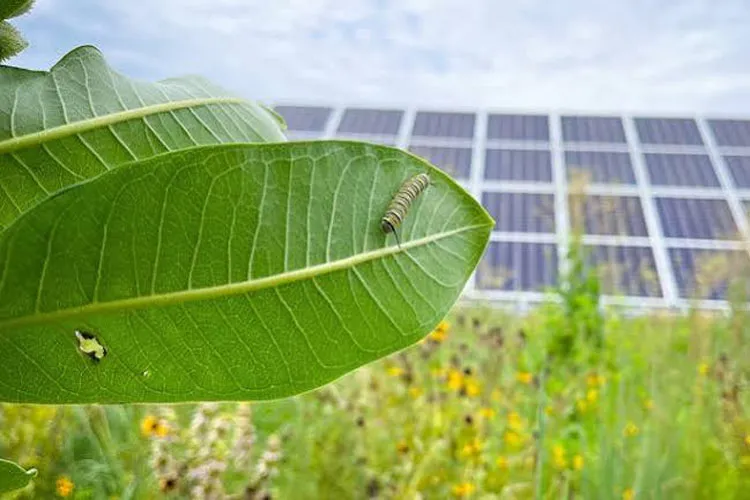
While a significant portion of agricultural land in the United States is leaving production, a new study shows these lands can be used to produce solar energy while simultaneously restoring natural habitats.
In 2025, the number of farms in the United States declined by about 15,000 units and the total area of agricultural land decreased by 2.51 million hectares; an area roughly equivalent to the size of the Island of Hawaii. However, abandoned agricultural lands do not quickly revert to natural habitats, and ecosystem recovery to desirable conditions can take decades.
Researchers at Argonne National Laboratory and the U.S. National Renewable Energy Laboratory examined whether installing solar panels and appropriate planning could allow these lands to be used both for electricity generation and biodiversity restoration.
Rapid return of native plants and insects
Researchers tested this approach at two solar sites in the state of Minnesota. The results showed that abandoned agricultural lands can, alongside solar energy production, become suitable habitats for native plant growth and the return of insects.
In this project, the abundance and diversity of native plants and insects, especially pollinators, increased in a relatively short time. Overall, it took less than four years for active habitats to form in these areas.
One of the most striking changes related to native bee populations. Around the second year, the planted vegetation reached maturity and conditions became favorable for a broad return of bees. In initial surveys almost no bees were observed in these areas, but by the fourth year bees were regularly present at the sites.
According to BGR, researchers observed, in addition to native bees, other insect species including honey bees, butterflies, moths, flies, and beetles. The number of insects surveyed nearly tripled over five years.
The impact of solar farms extends beyond the panel footprint
The environmental benefits of this approach are not limited to the area of solar panel installation. To assess the impact of habitat restoration on adjacent agricultural lands, researchers also examined soybean fields near the solar sites.
Results showed soybeans located near the solar farms experienced greater bee presence compared with soybeans near roads or even parts of soybean fields,.
Bee presence near the solar sites was even comparable to soybean fields adjacent to pastures covered by conservation reserve programs. This finding suggests creating pollinator habitat around solar panels can have positive effects on surrounding agricultural lands as well.
Designing solar farms to preserve biodiversity
Creating an environmentally friendly solar farm does not necessarily require complex technology, but its design and management must be done carefully.
In many solar projects, land is graded and its soil compacted before equipment installation. Paths and specific surfaces are also created for electrical equipment and access to panels. However, researchers at the two studied sites sought to minimize land preparation and, apart from creating access paths, did not carry out extensive grading.
They then planted a mix of native grasses and flowering plants in specific areas around the panels. Seed types were chosen according to the amount of light and moisture each section of the land received.
Another important design consideration at these sites was panel height. Because excessive vegetation growth can affect solar equipment performance, panels were installed at a height of more than 6 feet above ground. Solar tracking systems also adjusted panel orientation throughout the day according to the sun's position.
In the lowest position, the distance from the panels to the ground remained about 3 feet, leaving enough space for vegetation growth.
An opportunity for farmers and clean energy production
These findings, in addition to their environmental importance, can have economic significance for farmers. In the U.S. Midwest, which contains a significant portion of the country's fertile agricultural land, land lease offers for installing solar panels have reached about $1,250 to $1,500 per hectare.
Thus, using agricultural land for solar projects can, if properly designed, provide income for landowners while also helping restore vegetation cover and increase pollinator populations.
Researchers believe reducing land grading, using native plants, and smart vegetation management can turn solar farms from projects solely for energy production into habitats beneficial for wildlife. In some cases these lands can even be managed to support activities like sheep grazing.
This approach shows that solar energy development and biodiversity conservation are not necessarily in conflict, and proper solar farm design can enable simultaneous land use for energy production and ecosystem restoration.