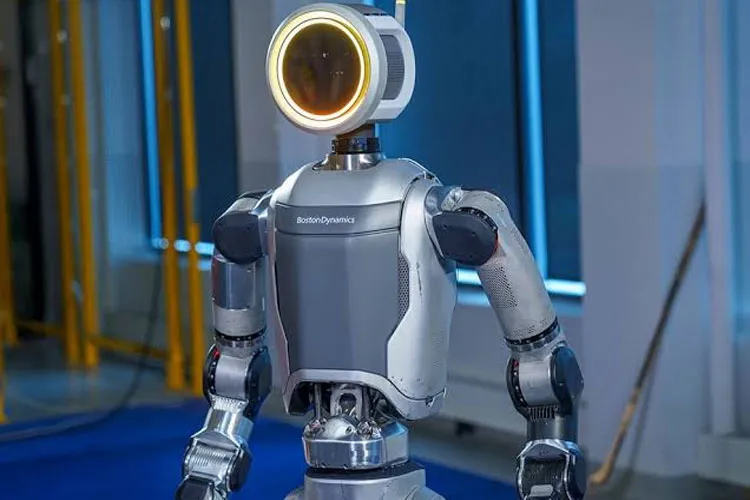
Samsung, by developing an in-house humanoid robot and expanding its investments in the robotics industry, is taking more serious steps to enter the humanoid robot market; a market where companies like Tesla, Boston Dynamics and Phenix are seeking to develop the next generation of AI-equipped robots.
According to reports published in South Korean tech media and their reflection in international sources, Samsung, alongside investing in robotics companies, is also pursuing an internal project to develop a humanoid robot. If this project ultimately reaches commercial production, Samsung would shift from being an investor and technology partner in the robotics industry to one of the direct players in this market.
Samsung’s in-house project to build a humanoid robot
Reports indicate that Samsung is developing a humanoid robot internally and independently of Rainbow Robotics; a company that in recent years has become an important part of Samsung’s robotics strategy.
It is said the internal project has reached advanced stages, but the company has not officially confirmed the existence of such a product nor provided information about its launch timing or technical specifications. Therefore, the released details about this robot should still be considered unofficial reports.
Samsung’s activity in robotics is not new. The company announced in December 2024 that it would invest about 267 billion won, equivalent to about 181 million dollars, to increase its stake in Rainbow Robotics. With this deal, Samsung’s share in that company reached about 35 percent and Samsung became its largest shareholder.
Samsung has also gained considerable experience in this field through ties with research teams related to HUBO, one of South Korea’s well-known humanoid robots.
RX Unit; Samsung’s Robotics Command Center
In July 2026 Samsung took a more significant organizational step to develop its robotics business by launching a unit called RX or Robotics Experience.
This unit is intended to become the hub for Samsung’s robotics activities and will operate directly under the CEO. Hardware development, AI, software and robotic product planning are among the areas pursued within this new structure; an approach that shows Samsung seeks to move robotics activities from R&D to commercial applications.
To lead this unit, Samsung appointed Lee Dong‑kun, a former Hyundai executive with experience in robotics strategy, including collaboration with Boston Dynamics.
The company also plans to establish robotics research centers in the United States, China and Japan; a move that could increase Samsung’s access to experts, technologies and key robotics markets.
Why is Samsung seeking to build humanoid robots?
Humanoid robots are one of the most important growing areas in physical artificial intelligence. Unlike purely software AI systems, these robots must be able to receive real-world environmental information via sensors and, using actuators, control systems and AI algorithms, take actions in the physical world.
Samsung has advantages in this area that many software companies do not possess. The company operates in fields such as semiconductors, displays, smartphones, home appliances, electronic components and mass production, and it has an extensive supply chain.
This infrastructure could in the future help Samsung produce a significant portion of the parts needed for robots at lower cost and larger scale. The company’s experience with motors, electronic components and production lines can also play an important role in developing next-generation robots.
Moreover, Samsung’s factories can become real environments for testing and training robots. These robots could first be used for tasks such as moving parts, inspecting products and logistical operations, and after gaining experience in controlled environments, be prepared for more complex duties.
Samsung has previously stated it will start its robotics applications in manufacturing and factories and later intends to expand the technology to environments such as homes and retail stores.
Samsung is not yet a direct rival to Tesla or Boston Dynamics
Despite these developments, Samsung’s entry into humanoid robots does not mean the company instantly becomes a direct competitor to Tesla or Boston Dynamics. Humanoid robot technology still faces serious challenges; from balance and natural movement to precise object manipulation, environment perception, energy management and ensuring safety.
However, Samsung’s combination of investment in Rainbow Robotics, potential development of an internal humanoid robot and the creation of the RX unit could create an integrated infrastructure for the company’s activities in the robotics industry.
Rainbow Robotics is particularly important in this context. The company works on robotic platforms and its technology portfolio includes products such as humanoid and quadruped robots. As a result, rather than starting from scratch, Samsung has access to the technology and expertise of an established robotics company.
The main competition is over physical AI
What makes Samsung’s move more significant is not merely trying to build a robot that looks human. The future competition in this industry will likely center on developing a complete physical AI system; a system in which AI, chips, sensors, actuators, software, data and manufacturing infrastructure come together.
Tesla has invested along this path with Project Optimus, and Boston Dynamics has a long history in developing advanced locomotion systems. Samsung, in contrast, can leverage its industrial capabilities and wide manufacturing chain to develop robots within its factories and then transfer the acquired technologies to other markets.
Nevertheless, until Samsung officially announces details of its internal robot, direct comparison with Tesla’s or Boston Dynamics’ products will remain largely speculative.
What has become clear so far is a set of obvious signals: investment in Rainbow Robotics, creation of the RX unit, development of specialized teams and plans to expand research centers in various markets. Together these actions indicate Samsung does not intend to be merely an investor or spectator in the race for the future of robotics and is seeking a serious position in the growing market of humanoid robots and physical artificial intelligence.