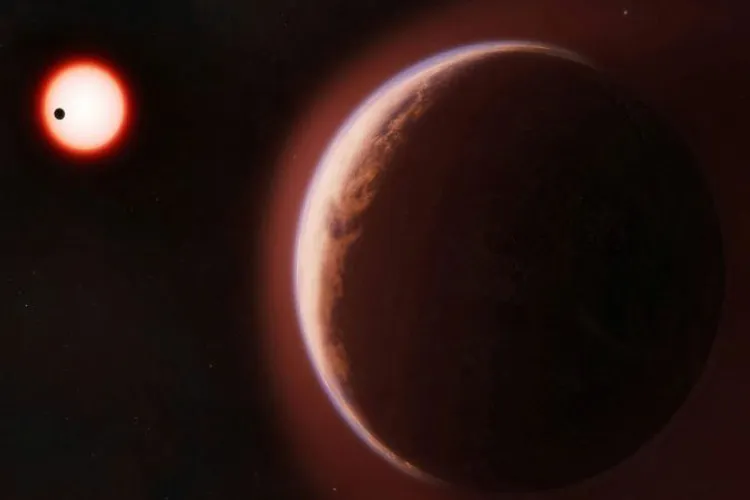
According to ITNA and citing SciTechDaily, the recent confirmation of an atmosphere around the rocky planet LHS 1140 b has generated a wave of interest in the astronomical community.
This planet orbits within the habitable zone of its parent star (a red dwarf 48 light-years from Earth). The habitable zone is the region around a star where temperatures are suitable for liquid water to remain on a planet's surface.
Astronomers have identified helium escaping from the upper atmosphere of LHS 1140 b, but heavier chemical compounds such as water - the key substance for life - could exist in the lower parts of its atmosphere.
Observing distant exoplanets with telescopes opens new doors for science, but will travel to these worlds and close-up viewing ever be possible?
While this topic has generally been seen so far as part of science fiction stories, emerging technologies allow us to imagine a future in which such missions could become possible in the coming decades.
There is particular interest in miniaturized spacecraft for interstellar travel, because steering a small spacecraft to another star system and delivering it within a human lifetime is easier and less costly.
Sensor miniaturization has made great advances, and researchers have even developed “smart dust” sensors millimeters in size or smaller that can detect light, temperature, or chemicals.
The probe itself needs some kind of propulsion capable of accelerating it to relatively relativistic speeds (for example, 10 to 20 percent of the speed of light). After a multi-decade journey, the sensors pass through the target star system without stopping and conduct in-situ observations.
Light sails are recognized as one of the most suitable forms of propulsion for such a mission. For interstellar voyages, directed laser energy can be used to push the spacecraft forward. Photons, the quantum packets of energy that make up light, carry momentum in addition to energy.
Thus, when light reflects off a mirror, it exerts pressure on that mirror. In most cases, the pressure from light is imperceptibly small, but for a sufficiently intense beam and an ultralight membrane mirror, radiation pressure can act as a means of spacecraft propulsion.
To accelerate a light sail to relativistic speeds requires a powerful laser with an effective output of tens of gigawatts, likely involving an array of separate laser devices. Pushing a reflective light sail with such a laser can bring it to cruise speed within minutes.
The advantage of beamed propulsion systems is that the laser array remains behind while only a small payload is accelerated toward the stars. By contrast, conventional rockets must carry their propellant, which constrains them for such missions.
Solar sails also operate using the pressure of sunlight, and small examples have already been launched into Earth orbit. Because solar sails do not need to carry propellant, they can perform long-duration, high-energy missions that are nearly impossible for conventional spacecraft.
Solar sails can also maneuver in unconventional orbits using light pressure to counteract gravity. For example, this enables a solar sail to hover at high altitude fixed over Earth's poles.
Solar sails and light sails are bridges from the present to the future and from exploration of the solar system to exploration of distant stars. Perhaps the exoplanet LHS 1140 b will one day be visited by a light sail in the not-so-distant future.