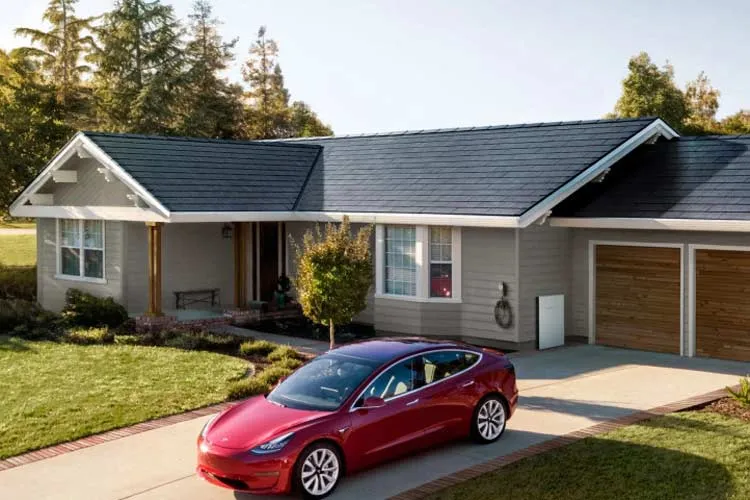
Almost a decade after unveiling Tesla’s “Solar Roof,” the product has gradually disappeared from the company’s official website; a sign that could indicate the end of one of Tesla’s most ambitious projects in solar energy.
Tesla has now removed all public references to the Solar Roof from its website. Checks show the product’s dedicated address redirects to Tesla’s public solar energy page and the support pages related to the Solar Roof have also been redirected.
However, removing the Solar Roof from Tesla’s website doesn’t necessarily mean its immediate discontinuation. Two companies active in solar system installation told TechCrunch they still have the ability to supply Tesla’s Solar Roof. One of those companies emphasized that product availability depends on project scheduling. This could indicate Tesla is gradually drawing down remaining inventory of the product.
Why didn’t Tesla’s Solar Roof reach its goal?
Tesla’s Solar Roof was introduced from the start with very ambitious goals. The company intended to eventually install around a thousand Solar Roofs per week; but after years of attempting to refine the design and improve manufacturing and installation processes, that number reached about 20 to 40 units per week in 2022 - a striking gap from Tesla’s initial target.
One of the most significant obstacles was the high price of the product. Tesla marketed the Solar Roof as a luxury option and in its advertising compared its cost to the combined expense of installing conventional solar panels and replacing a roof.
At first glance, this argument could have made the Solar Roof an attractive option; especially for customers who disliked the appearance of conventional solar panels. But in practice, project costs were very high for some customers, and there were even reports of prices around $200,000 for installing the system.
Main problem: the Solar Roof was not scalable like conventional panels
One of the main advantages of conventional solar panels is mass production. With rising global demand for solar energy, billions of standard cells are manufactured worldwide and assembled into panels with relatively similar designs. This production scale has driven the cost of solar panels down sharply in recent years.
According to TechCrunch, Tesla’s Solar Roof was different. Although it used silicon-based solar cell technology, the tiles themselves had a proprietary design. Therefore Tesla needed specialized equipment and processes to manufacture them.
When sales volume did not meet initial forecasts, the cost of that equipment and production process was spread over fewer products. As a result, the Solar Roof could not benefit from the economies of scale enjoyed by standard panels.
Heat didn’t help Tesla either
The Solar Roof’s problems were not limited to price and limited production. Reports also emerged about thermal issues with the system; including warping of some non-solar components and even melting of the roof’s underlayer.
More importantly, there were reports of lower-than-promised power output. While pinpointing the exact cause of reduced output is not easy, high temperature can be one contributing factor.
Solar cells, like many electronic devices, perform better at lower temperatures. Typically, increased temperature reduces a cell’s output voltage and affects its performance.
Conventional solar panels are usually mounted at a certain distance from the roof surface. This gap allows air to flow beneath the panels and helps cool them. Tesla’s Solar Roof also had such a space for thermal management, but the distance between the energy-generating surface and the roof was smaller than in common systems. That could increase temperature and reduce some of the solar cells’ efficiency.
Did Tesla cause the failure of solar roofs?
Removing the Solar Roof from Tesla’s website can be an important sign for the future of the technology, but it’s still not possible to say the idea of integrated building solar roofs is finished.
Companies like GAF and Merlin Solar are still trying to capture part of the integrated solar roof market. Additionally, some customers may still prefer a product that preserves the traditional roof appearance rather than installing large, visible panels on top.
Nevertheless, Tesla’s retreat could be a significant blow to the idea. The Solar Roof was one of those products Tesla introduced with promises to revolutionize the energy and construction industries; but the gap between its initial goals and its actual performance ultimately became very large.
The key question now is: if a company with Tesla’s financial resources, technology, and strong brand could not make the Solar Roof a widespread and economical product, does this technology fundamentally face a structural problem?
Perhaps removing the Solar Roof from Tesla’s offerings is the end of an expensive experiment; or perhaps it’s simply an opportunity for another company to take the same idea to success with different design, manufacturing, and economic models.