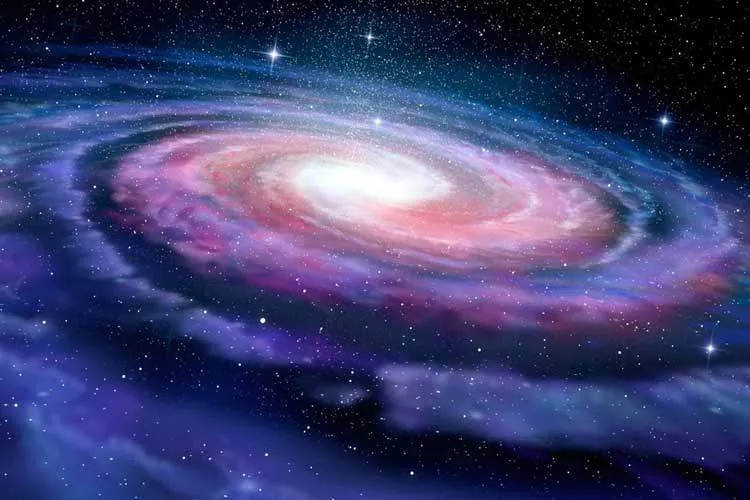
Our galaxy has experienced turbulent events in its past, including mergers with other galaxies. The new discovery by the Hubble Space Telescope now shows that about 12 billion years ago, the Milky Way also swallowed a dwarf galaxy.
Our galaxy, the Milky Way, with at least between 100 to 400 billion stars, resembles a disk about 100,000 light-years across (according to some estimates even up to 200,000 light-years) and about 1,000 light-years thick.
According to what cosmology tells us today, our galaxy has experienced turbulent events in its lifetime, each of which probably lasted billions of years.
One of the most recent experiences of our galaxy, which is still ongoing, has been its merger with the Sagittarius dwarf galaxy (Sgr dSph), which cosmologists believe occurred about 6 billion years ago.
Scientists say this dwarf galaxy fell into the Milky Way. Before that, the most massive known merger the Milky Way experienced was its merger with the Gaia-Enceladus-Sausage (GSE) dwarf galaxy, which ended about 10 billion years ago.
It appears that the Milky Way’s swallowing of Gaia-Enceladus-Sausage had a significant impact on the structure of our galaxy’s stellar disk. Previous observations and simulations had indicated that before these two major mergers, another major merger had occurred.
Scientists believe several other accretion events also occurred between these two important mergers, i.e., between 6 and 10 billion years ago, all involving smaller dwarf galaxies.
Nevertheless, reconstructing what happened in the earliest stages of the Milky Way’s life at times earlier than this - that is, more than 10 billion years ago - is considerably more difficult, and the further back in time we go, the less massive our galaxy was.
What is certain is that billions of years ago our galaxy was not as it is now, and it gained part of its current size by swallowing smaller galaxies.
NASA’s Hubble Space Telescope has now unveiled conclusive evidence of a merger of a dwarf galaxy with the young Milky Way in its earliest stages of evolution. The findings, now published in the journal "Nature Astronomy," push our knowledge of our galaxy’s history back by 1.8 billion years compared to before.
Researchers say the Milky Way grew to its present state both by forming new stars from its gas clouds and by merging with other galaxies, collecting their stars, gas, and dark matter.
Now the Hubble Space Telescope has discovered definitive evidence of an older merger that scientists believe occurred about 11.8 billion years ago, that is, only 2 billion years after the Big Bang and the emergence of the universe.
Scientists at the Institute of Astronomy and Space Sciences in Bologna, Italy, say we can now guess where the first major set of building blocks of our galaxy came from. The answer is a dwarf galaxy they call Low-energy-Kraken-Heracles, or LKH for short.
An archaeological-like search in the depths of the galaxy
Astronomical surveys and the very precise data from the European Space Agency’s Gaia mission have put together the pieces of our galaxy’s history puzzle with high precision.
Scientists say that when our galaxy was young it was smaller and in size more similar to the galaxies it collided with. At the same time, the environment of such mergers was more chaotic, and it is possible that the signs of mergers between galaxies have faded over billions of years.
Now cosmologists, using Hubble’s high resolution and imaging depth, have been able to measure the ages and metallicities of observed clusters with unprecedented accuracy. Combining these data with Gaia observations allowed scientists to identify a population of globular clusters that differ from the rest. Researchers say these different clusters are the ones that formed in LKH and tell us when that galaxy was swallowed by ours and how massive it was.
In this study, the researchers analyzed Hubble observations of 39 globular clusters in the inner 20,000 light-years of our galaxy. According to them, this is the region of the galaxy where one expects the oldest merger evidence to be preserved. The researchers expected this sample to include both globular clusters formed in the young Milky Way and clusters that were added to the Milky Way about 10 billion years ago from the Gaia-Enceladus-Sausage dwarf galaxy.
In their analysis, scientists concluded that these clusters originated from an independent and even older merger. In that merger, the Milky Way accreted a dwarf galaxy whose stellar mass was about 500 million times the mass of our Sun and at that time constituted a significant fraction of our galaxy’s mass.
Researchers now intend to continue their study of the Milky Way’s globular clusters to reveal the galaxy’s history. Their goal is to list all the major mergers our galaxy has experienced throughout its cosmic history.
The growth and evolution of our galaxy will continue
What the Milky Way has experienced in its evolutionary history is of course not the end of the road. Scientists say our galaxy still has a long way to go and, among other things, will merge with our neighbor Andromeda in about four and a half billion years.
They say that as a result of this merger, a new giant elliptical galaxy called Milkomeda will form.
According to researchers, this event will be a massive galactic collision during which stars will rarely collide directly, but the central black holes of the two galaxies will merge and the structures of both galaxies will be completely transformed and their spiral arms will disappear.
Although by that time the Solar System will probably be safe from direct stellar collisions, the merger of the two galaxies will produce gravitational changes and alter the positions of the Sun and Earth.