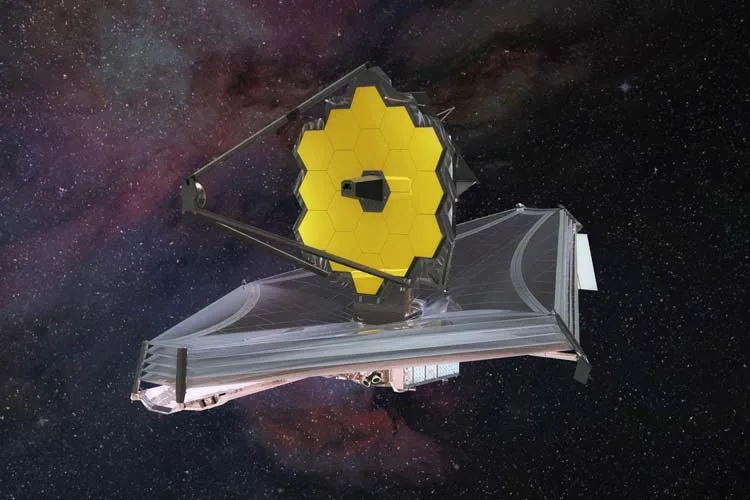
New observations from NASA's James Webb Space Telescope have deepened the mystery of a young yet unexpectedly mature galaxy cluster in the early universe.
According to Eitna and citing SciTechDaily, a research team led by scientists at IPAC, a science and data center at the California Institute of Technology, has shown in three recent papers that this cluster is the most distant known example of a strong gravitational lens produced by a galaxy cluster.
These findings, based on observations from the James Webb Space Telescope, were presented at the 248th meeting of the American Astronomical Society. Astronomers immediately realized the galaxy cluster XLSSC 122 was unusual upon observing it.
Although this cluster lies more than 10 billion light-years away, a time when other galaxy groups were just forming, the cluster appeared highly evolved.
James Webb’s unparalleled ability to collect light and reveal fine details showed that XLSSC 122 is aligned with one or more more distant galaxies. Due to this chance alignment, the cluster’s powerful gravity bends the light of the more distant galaxy, creating the very rare effect known as a strong gravitational lens.
This effect has allowed scientists to make a more precise measurement of XLSSC 122’s mass. Kyle Finner, an IPAC scientist and lead author of the first paper, said: “When we received the first images from James Webb, we said, ‘Wow, look at this, a strong gravitational lens is coming from this cluster!’”
Cluster XLSSC 122 now holds the record for the most distant galaxy cluster showing a strong gravitational lens, a valuable tool for astronomers. This lucky alignment has given astronomers their most precise view of how mass is distributed within an early galaxy cluster from the “cosmic noon” era (about 10 billion years ago).
In that critical era, galaxy clusters began forming in large numbers and the star-formation rate peaked.
Cluster XLSSC 122 continued to defy expectations. Its mass is highly concentrated toward the cluster center. Finding such a concentrated structure early in cosmic history makes it difficult to reconcile with standard cosmological models.
Finner states: “XLSSC 122 is one of the first clusters we know formed in the universe and has a mass concentration that does not agree with the predictions of our cosmological model.”
After identifying the strong gravitational lens, Finner and his colleagues published two more papers that used James Webb to examine other properties of the cluster. Overall, the results indicate that XLSSC 122 is a key example of cluster formation during cosmic noon.
Notably, the visible matter in XLSSC 122 accounts for only a small portion of the strong lensing effect. Most of the effect arises from dark matter. Dark matter is fundamental to cosmology because it helps hold galaxies together and shape the universe’s large-scale structure.
Measuring the dark matter distribution in XLSSC 122 provides a stringent test for cosmological models. Finner says: “Strong gravitational lensing is a way to measure dark matter without seeing it directly and is a sensitive probe for our cosmological models.”
In the second paper, the research team examined a subtler form of lensing called weak lensing, which produces much smaller distortions in galaxy shapes. These wider views, together with X-ray and radio observations, showed that XLSSC 122 is still undergoing mergers.
In their third paper, they used James Webb to trace intracluster light-the faint glow of stray stars between the cluster’s galaxies.
This is the oldest known detection of intracluster light. The research team also found that the central shape of the intracluster light closely matches the dark matter concentrations revealed by the strong gravitational lensing.
Finner and his colleagues now hope to identify and study many more very distant galaxy clusters. James Webb was not designed to discover large numbers of such rare objects, so astronomers will need X-ray and radio sky surveys.