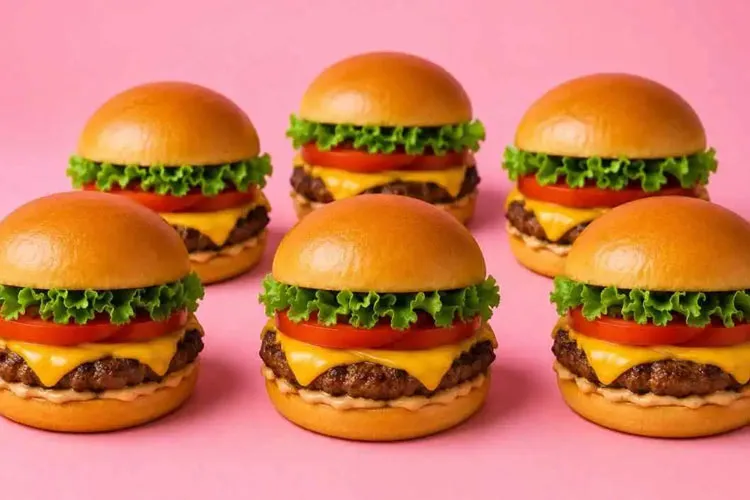
AI-generated images have gradually made their way onto restaurant menus, but the problem is that some of these images can create a sense of disgust rather than stimulate the customer's appetite.
Images of foods produced by AI tools sometimes look overly perfect; from pastries with unnaturally symmetric loaves to perfectly round scoops of ice cream and prawns whose appearance noticeably differs from real examples.
Alex Lessel, chief technology officer of Reality Defender, explains this phenomenon by saying some AI-generated food images look like a product "an alien tried to make a pizza without understanding the basic principles." According to him, this unnatural appearance is the result of how AI models operate and their attempt to identify and reproduce patterns present in the training data.
Large language models and diffusion models that underlie tools like ChatGPT and Midjourney are trained on vast amounts of data and use the patterns in that data to generate new content.
Lessel says many of the images these models produce closely resemble pictures found in old chain-restaurant menus; because such images are also part of the data AI models were trained on.
When AI over-perfects food
This issue can become more complicated as AI-generated content enters the training-data cycle. One concern raised in this area is a phenomenon known as "model collapse"; a situation where the continual use of synthetic data in model training can lead to a decline in output quality.
However, Lessel sees what happens in menu images more as a kind of "convergence." In this case, different AI outputs gradually become similar to one another and the diversity and unique features of images are reduced, without the model necessarily becoming entirely useless.
The similarity among chain-restaurant menus and the repeated use of previous outputs as training data can reinforce this trend.
Lee Renee from Illinois State University also believes attempts to improve data with the goal of producing content more pleasing to users can lead to a kind of homogenization. Simply put, AI tends to remove unusual features and the "edges" of images and ultimately produces outputs that are visually more perfect yet at the same time less realistic.
Repetition makes food images stranger
An experiment on the social network X also showed signs of this phenomenon. A user named Laptech repeatedly edited an AI-generated menu and after 100 regenerations noticed the food images gradually resembled real examples less.
In this process, the shapes of the foods shifted more toward round and smooth forms and the natural, irregular features found in real foods diminished. Repeating the experiment produced a similar result.
But the issue is not only the strange appearance of these images. Researchers at the University of Duisburg-Essen found that images that appear nearly completely real but contain subtle, unnatural cues may provoke more disgust in viewers compared with overtly fake images.
This is particularly important for the restaurant industry; because the main goal of images on a menu is to stimulate appetite and create positive anticipation in the customer. If a food image looks too artificial or unnatural, it may have the opposite effect.
On the other hand, this problem is not limited to restaurants. The proliferation of AI-generated images and videos has made trust in visual content a serious challenge.
Lessel believes photos and videos can no longer be considered as reliable evidence as they once were; a change that, in his view, is one of the fundamental transformations resulting from the spread of AI in everyday life.