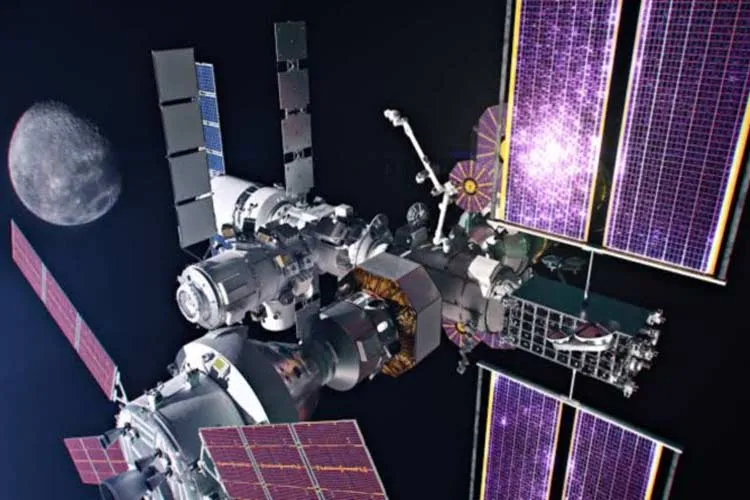
Over the next two decades, NASA's Gateway space station could become the first lunar spaceport, hosting Orion capsules, lunar landers, cargo spacecraft, and astronauts traveling between Earth, the Moon, and eventually deep space.
Unlike terrestrial airports, Gateway will not have runways, taxiways, or gate announcements. Instead, spacecraft will move through an invisible network shaped by the gravity of Earth, the Moon, and the surrounding region, and trajectories will be governed by precise mathematical rules.
Managing that traffic requires a kind of "orbital control tower." Engineers at Texas A&M University, NASA's Johnson Space Center, and Purdue University have developed algorithms and operational strategies for spacecraft waiting near Gateway and for managing multiple vehicles moving in the same orbital environment.
This research examines how to balance fuel consumption and operational needs while reducing the risk of spacecraft collisions.
Dr. Dyanne Davis, an associate professor of aerospace engineering and an author of the study, says: "The future of lunar exploration depends on traffic management as much as rocket science."
According to Eitna, quoting SciTechDaily, establishing a sustainable human presence near the Moon requires more than getting there. Spacecraft also need infrastructure that allows them to occupy and move in the same gravitational environment without interfering with one another. For Gateway and visiting spacecraft, that environment is concentrated around a near-rectilinear halo orbit.
According to Davis, this orbit, which is nearly stable and very elongated around the Moon, provides uninterrupted line-of-sight for communications with Earth and requires little fuel to maintain. However, Gateway and nearby vehicles will experience continuously varying gravitational pulls from both Earth and the Moon along this elongated orbit.
This path differs from any orbit previously used for crewed spacecraft, taking Gateway to 1,600 kilometers above the Moon's north pole and then carrying it roughly 64,000 kilometers beyond the south pole.
A single station can remain on course with occasional burns. But when an Orion crew capsule, an uncrewed cargo vehicle, and a large lunar lander might all need to approach, dock, depart, or wait in the same area, the situation becomes more complex.
Davis emphasizes that collisions and serious damage can occur, and effective traffic management in this orbit is critical for crew safety and mission success. One of the system's central ideas is "hovering in place," meaning keeping a spacecraft relative to a particular orbit or path while waiting.
The concept is essentially similar to airport traffic management, where aircraft may wait at gates or stop on taxiways or circle before receiving clearance to move. The main difference is that there is no fixed surface and every vehicle is in motion.
Davis explains that each spacecraft is constantly moving, and this is a "Goldilocks" zone that keeps "parked" vehicles far enough apart from one another while close enough to their destination for resources to be used efficiently.
Using thousands of computer simulations, engineers tested ways to properly separate spacecraft around Gateway, accounting for realistic navigation errors, imperfect thruster performance, and small disturbances that future Artemis missions might experience.
The simulations showed that a modest increase in station-keeping maneuvers can bring spacecraft significantly closer to their planned positions while requiring only small changes in fuel consumption. Davis says that greater positional accuracy allows mission planners to predict where each spacecraft will be and preserves valuable fuel.