The story began with the public release of one of the most precise neural maps made of an animal. Researchers at HHMI Janelia and Google Research have prepared a complete map of the central nervous system of an adult male fruit fly; a map that includes about 166,000 neurons and 25.6 million synaptic connections. These data were made public on September 3, 2026, and very quickly programmers and independent researchers began using them for various experiments.
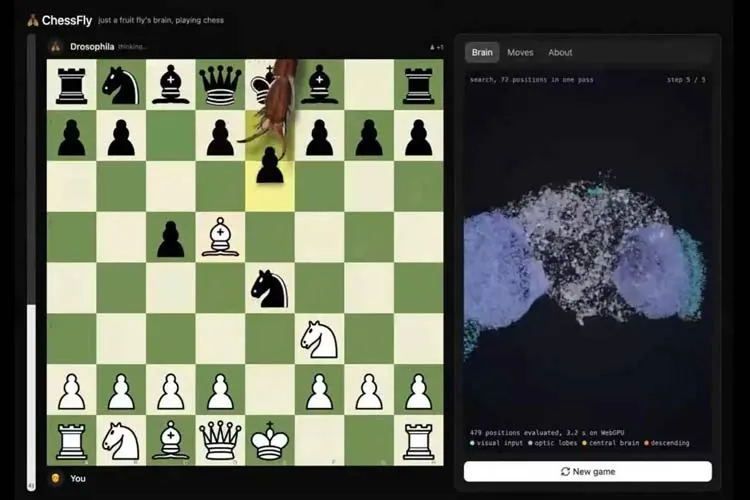
One of these projects is ChessFly, developed by Maxim Labun. In this project, a network based on the fly's neural connections is used to receive the chessboard state and select the next move. The constructed model was pitted against Claude Opus 5 and, according to the published report, managed to finish the game in just 11 moves.
The fly really does not play chess
Despite the exciting headlines published about this experiment, there is an important difference between the "fly brain" and the computational model inspired by it. No real fly sat behind the chessboard and the neural map was not directly transformed into a chess player without modification.
In the ChessFly implementation, the network's connectivity structure was taken from the real fly brain data, but parts such as how the chessboard state is converted into neural input, the connection strengths, neuron properties, and the layer that converts network activity into a chess move were trained. Even in this project a limited deep search was used to select moves. Therefore the result is more an engineering experiment to use a biologically inspired neural architecture for a new problem than a direct comparison of a fly's intelligence with a large language model.
The map that led to strange experiments
The public release of this neural map has not been limited to chess. Various developers have used the fly's digital neural structure to control video games, robotics experiments, and even simulate cryptocurrency trading.
In one example, a character in a fighting game was controlled using the fly neural network and was able to beat a human player in a series of matches. Other projects have connected the network to robots and small aircraft to test its ability to control movement.
There is even an example of running Doom using the simulated fly brain model; an experience that shows a neural network with a structure derived from a living creature can, after receiving appropriate inputs, be used for tasks that have no direct relation to that animal's natural behavior.
Why does the chess result matter?
The importance of this project is less about the "fly beating AI" and more about the engineering question behind it: can neural structures of living organisms be repurposed to solve new problems?
The fly brain is very small compared to the human brain, but it contains a complex network of neurons and connections. Now that the map of this network is publicly available, researchers and developers can reconstruct its structure in digital environments and see what kinds of behaviors emerge when it receives new inputs.
Of course, one should not conclude from this experiment that a real fly brain is more capable than Claude or other powerful AI models. Even in the ChessFly project, parts of the model were trained to perform the chess task and the result is a controlled experiment for a particular implementation, not a general benchmark of intelligence. The published specifications for the model also indicate its performance as a chess player is still far from specialized chess engines.
In fact, the most fascinating part of this story may not be the chess game itself. The release of the fly's neural connectivity map has allowed researchers to have a "biological neural circuit" as raw material for computational experiments; a path that could in the future help better understand how information is processed in brains and also aid in designing new AI architectures.