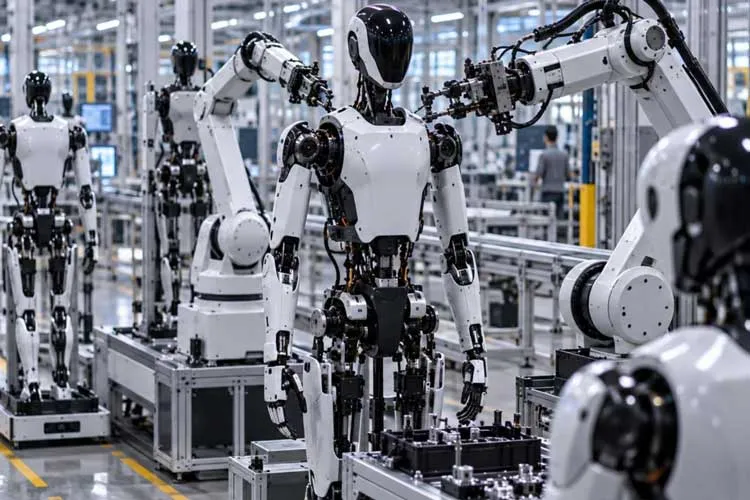
The world's first smart factory for the industrial production of humanoid robots, with an annual capacity of 10,000 units, has officially started operating in China; a factory where robots build robots.
This facility, located in Liuzhou in the Guangxi region, is the result of a joint investment by Siemens and the Chinese company UBTECH Robotics, which specializes in robotics. In this factory, instead of relying on human labor to assemble parts, "embodied AI" - that is, AI used in physical robots - and digital twin technology will be used.
Meaning Siemens, to ensure the factory achieves a 10-minute production cycle, created a "digital twin" by virtually simulating the entire 14,000-square-meter factory so that the performance of its different sections could be simulated and tested before launch.
The factory can operate at this speed without parts getting stuck. The assembly robots, using three-dimensional vision and tactile feedback, place very small parts accurately in the right spot without human supervision.
The wheeled mobile "CRUZR" robots, which are equipped with robotic arms, can, using 3D mapping of the environment, repeatedly unload items from pallets, organize boxes, and refill parts storage bins without human help. In addition, automated guided vehicles and automated forklifts move parts from the warehouse to assembly stations.
After assembly, the products are subjected to rigorous dynamic stress tests for four hours to ensure flawless performance of all components.
Dangers and challenges of the humanoid robot factory
This factory could be a solution to China's growing labor shortage. China currently faces a shortage of 30 million workers in the manufacturing sector. Young people are also increasingly disinclined to manual jobs on assembly lines, which has exacerbated the labor shortage.
This factory model allows humanoid robots to take on repetitive and dangerous tasks and perform up to 20 percent of the factory's workload.
Using humanoid robots reduces the risk of human error in precise tasks. Thus tasks such as tracking, scanning, and securing thousands of complex parts are performed without errors. A coordinated network and synchronized workflow also ensure efficiency.
Despite these advantages, critics say embodied AI technology is still relatively nascent and may struggle in real-world, unpredictable work environments. The question also arises whether the global market can absorb 10,000 humanoid robots annually. Markets may not be ready to purchase these robots before long periods of safety testing.
With humanoid robots replacing manual jobs, concerns about economic welfare also emerge. If adequate social support mechanisms and programs for transitioning workers to new jobs are not in place, the global economy could face severe disruption, as thousands rely on factory wages or the platform economy for their livelihoods.
Global perspective
According to Insider Paper, mass production of high-speed robots tailored to automotive industry standards and needs has raised public concerns, and social media users have expressed alarm about the pace of this technology's advancement. They say the idea of robots building their own kind is reminiscent of dystopian science-fiction films.
Some political analysts also believe the U.S. and China have entered a kind of "robotic cold war." China has taken the lead in the scale of producing physical hardware, while large American companies are focusing on developing software and prototypes.