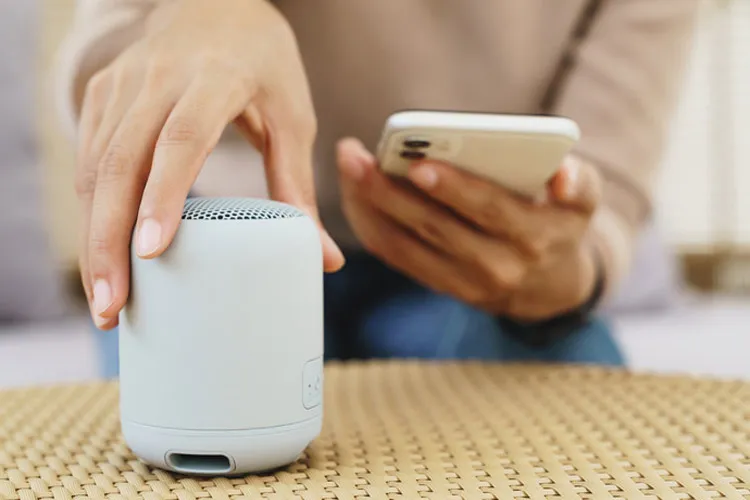
Bluetooth has for years become one of the most common ways to wirelessly connect devices such as headphones, speakers, keyboards, and gamepads. This technology was originally designed for short-range communication, but advances in new standards have allowed its supported distance in some conditions to be far greater than commonly assumed.
However, the numbers announced for Bluetooth range usually refer to ideal conditions. In real use, walls, metals, distance, transmitter power, and even battery charge level can affect connection quality.
How does the Bluetooth version affect range?
The Bluetooth version is one of the important factors in determining a device's communication capabilities. Older versions, i.e., versions earlier than Bluetooth 4.0, typically have a range of about 30 to 33 feet, roughly 9 to 10 meters.
Bluetooth 4.0 to 4.2 can offer greater range in suitable conditions, and in some scenarios this distance reaches about 200 feet or 61 meters. Bluetooth 5.0, in theory, can reach a range of about 800 feet, i.e., close to 244 meters, under ideal conditions.
Of course, these numbers do not mean that every phone or headphone equipped with Bluetooth 5 can cover such a distance in the real world. Environmental conditions and the hardware specifications of devices have a large impact on the final result.
Bluetooth operates in the 2.4 GHz frequency band; the same range used by many Wi‑Fi networks and some other equipment. For that reason, radio‑crowded environments can reduce connection quality or range.
Bluetooth class also matters
Another determining factor is Bluetooth power class. This technology is divided into three main classes, each with different transmission power and range.
Class 1 is designed for equipment that needs greater range. These devices can have a range of up to about 330 feet, approximately 100 meters, in suitable conditions, but they consume more transmission power; therefore they are more commonly seen in industrial equipment and long‑range adapters.
Class 2 is the class used in many consumer products such as smartphones, wireless headphones, and speakers. The nominal range of this class is about 33 feet or 10 meters, and its lower power consumption makes it suitable for portable devices.
Class 3 has the lowest power and range and is used for very short‑range communications. The range of this class is about 3 feet, i.e., less than one meter, and it has very low power consumption.
What reduces Bluetooth range?
Even if two devices use the same Bluetooth version and class, environmental conditions can produce different results. Walls, especially thick concrete walls, and also metal objects can attenuate the signal.
In contrast, materials such as wood, glass, and plastic usually do not create a serious barrier to signal passage. The human body can also reduce connection quality when in the signal path.
Device battery charge level also matters, because lower transmission power can affect connection performance. In addition, the presence of Wi‑Fi routers, mesh nodes, and other wireless equipment nearby can increase interference in the 2.4 GHz band.
For this reason, to achieve the maximum possible range, it is better for devices to be positioned as directly as possible to each other and for obstacles and potential interference sources to be removed from between them. Of course, for establishing a Bluetooth connection, a direct line of sight is not required and the signal can pass through many obstacles.
Can Bluetooth signal be boosted?
For the average user, there is no simple way to directly boost the Bluetooth signal at the source. In practice, the most important approach is to use devices with newer standards and better hardware.
You can also improve connection conditions by keeping devices charged, reducing radio interference, and minimizing physical obstacles. If the distance between two devices is large, maintaining a relatively open path between them can also help stabilize the connection.
Bluetooth in recent years has gone beyond being merely a short‑range technology, and new standards have given devices more capabilities. With continued development of this technology, increased data transfer capacity and improved wireless communication performance may expand Bluetooth applications at greater distances.
As a result, a single fixed number cannot be determined as the real Bluetooth range for all devices. The final range depends on a combination of Bluetooth version and technology type, power class, the hardware design of devices, the environment, and the level of interference.