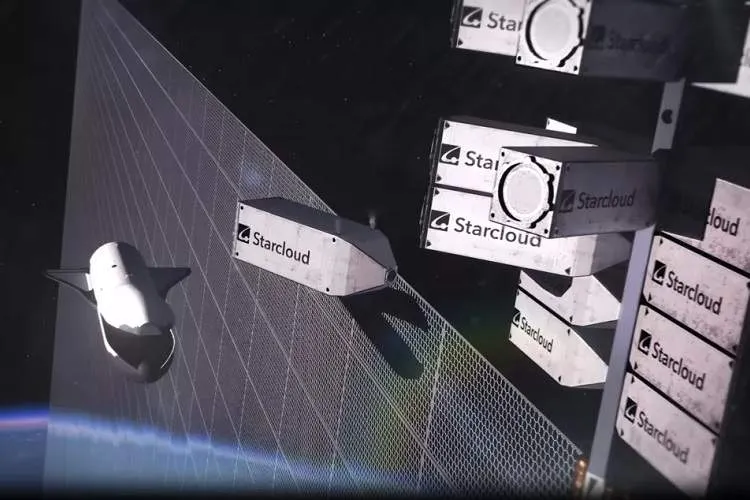
Starcloud, which is backed by Nvidia, intends to take Bitcoin mining to space.
According to ICTna via Techspot, the company says that if its plans proceed as expected, Starcloud-2, which is scheduled to launch in early 2027, will be the first mission to use dedicated hardware for Bitcoin mining in Earth orbit.
Starcloud's idea is based on abundant access to solar energy in space and the use of dedicated mining devices known as ASICs.
The company's CEO says an Nvidia B200 GPU consuming one kilowatt has about $30,000 in hardware costs, while an ASIC with similar consumption costs about $1,000.
Of course this comparison is merely hardware cost per one kilowatt of power and does not mean a thirtyfold superiority of ASICs in mining efficiency.
Starcloud's main goal goes beyond cryptocurrency mining, and the company aims to build space datacenters. On the previous mission, an Nvidia H100 GPU was sent to Earth orbit. The Starcloud-1 satellite, which weighed about 60 kilograms, was launched in November 2025 and served as an initial test to examine the feasibility of computational processing in orbit.
Starcloud-2 is intended to be the commercial and developed version of this idea and will host a collection of GPUs, persistent storage, continuous access, and dedicated power supply and thermal management systems.
A sun-synchronous orbit also enables extensive use of solar energy.
Google is also pursuing a similar idea called Project Suncatcher, which will use tensor processing units and optical communications between satellites.
However, the biggest problem for Bitcoin mining in space may be cooling. In a vacuum there is no air to transfer heat by convection. Therefore equipment must transfer heat to radiators so that this energy is expelled as infrared radiation into space.
The radiator size, operating temperature, and surface properties all affect the rate of heat dissipation.
On the other hand, ASICs may become obsolete faster than GPUs and provide less time for return on investment.
On Earth, some miners can generate electricity using sources like flare gas at a cost of about 2 to 3 cents per kilowatt-hour. Therefore, the success of Bitcoin mining in space will depend on launch costs, cooling, and the economic lifetime of the equipment.