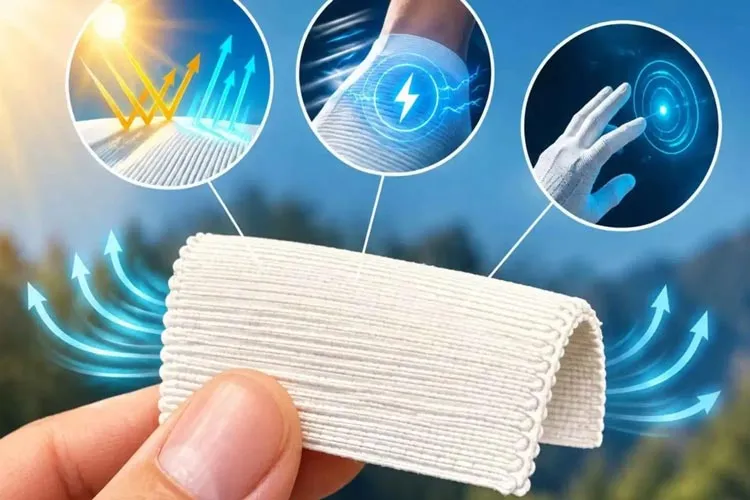
Humans have worn clothes for tens of thousands of years for protection and comfort. Despite advances in the textile industry, the primary function of clothing has not changed much. A recent study published in Advanced Science could change that. Scientists at the University of Illinois in the United States have created a smart fabric that simultaneously cools the body, senses motion, and generates electricity, all without additional layers or integrated electronic circuits.
Thermal shield for the body
This fabric is based on printed PDMS polymer and reinforced with zirconium dioxide (ZrO₂). The result is a lightweight, flexible, washable, and breathable fabric. The researchers converted this material into a fibrous structure using Direct Ink Writing.
Zirconium dioxide produces a cooling effect through two mechanisms. First, it reflects about 96 percent of direct sunlight. Second, by thermal radiation, it sends body heat out to the surrounding environment. This technology keeps the temperature beneath the fabric 3 to 6 degrees Celsius lower than the surrounding air. This feature is especially valuable for workers who must remain outdoors for hours during heat waves. In the scientific text of the paper, the solar reflectance of this printable composite is reported as about 97.3 percent and its infrared emissivity as about 96.9 percent.
Motion sensor and power generator
The fabric’s capabilities are not limited to cooling. When a person moves, friction between the fabric and skin generates static electric charge; a phenomenon known as the triboelectric effect. The dielectric property of zirconium oxide enhances the accumulation of this charge. For this reason a single material is used both for radiative cooling and for generating electricity from motion.
The electrical power produced is small, about 47 milliwatts per square meter, but it is sufficient to power small, low-power devices and can also act as a motion sensor. The researchers also demonstrated that the triboelectric signals generated by motion can instantaneously activate Joule heating. Thus the fabric can switch between passive cooling and active heating depending on conditions.
From sportswear to smart gloves
The most obvious initial application of this fabric is cooling sportswear, but its range is broader. The researchers placed pieces of the fabric on the elbow to monitor arm movement, then used it on fingers to record and interpret sign-language signals. These results pave the way for using the fabric in interactive accessories, such as smart virtual-reality gloves.
The researchers confirmed the fabric’s flexibility and breathability. The next challenge is to assess its comfort in daily and long-term use.
This fabric is another example of researchers’ efforts to create multifunctional garments; clothing that, instead of relying on batteries and complex circuits, uses the material’s own properties for cooling, sensing, and energy generation.