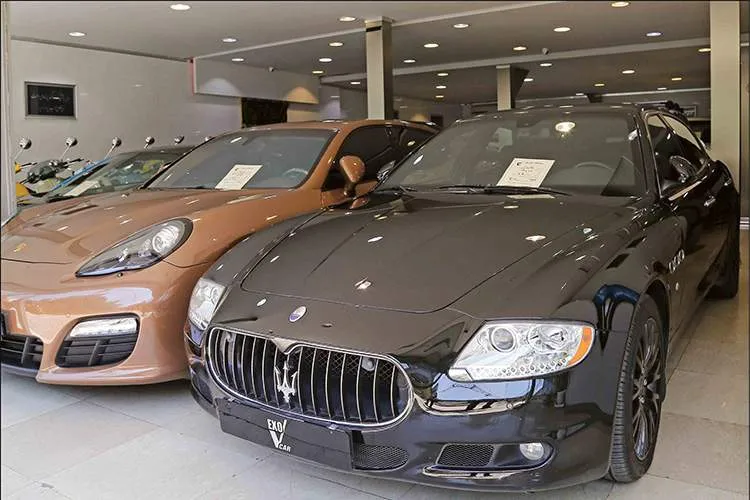
The Minister of Industry, Mine and Trade announced the ban on importing luxury cars by order of the President and emphasized that from now on the procedure for car imports will be pursued only in the direction of bringing economic products for the general public.
According to ISNA, the file of car imports in recent years has oscillated between facilitative policies and the realities of the foreign exchange market, while clauses such as imports with individuals' foreign currency or import permits for Iranians living abroad were initiated with the justification of not relying on official reserves; however, the financial flow chain of these schemes shows that monetary policymakers and members of parliament have serious concerns about the consequences of this practice and its impacts on the country's exchange rate stability.
This comes while recently a member of the Parliament's Economic Commission warned on a television program that allocating foreign currency resources to the import of foreign cars, especially luxury ones, under the country's foreign exchange constraints is not economically justified, and the increase in car imports and the allocation of foreign currency resources to expensive consumer goods is taking place while the country needs strict management of foreign currency consumption for essential goods and medicine.
Meisam Zohourian, referring to the growth of imports of expensive and luxury cars, said: Such a practice fuels increased demand for foreign currency and ultimately the pressure resulting from it falls on the value of the national currency, and while 100 percent tariff policies effectively prevent access to these cars by the poor and even middle classes and merely realize revenue benefits for customs without resolving the market's fundamental challenges; therefore reducing the share of foreign currency for essential goods and directing resources toward car imports is not consistent with the principles of economic justice and optimal management of national resources.
In this regard, Mehdi Darabi, Assistant to the Governor of the Central Bank for Foreign Exchange Affairs, rejecting the ineffectiveness of car imports by Iranians residing abroad on the country's currency market, reported the formation of a reverse cycle of capital outflow through imports by persons residing abroad.
According to him, in the process of car imports by Iranians abroad, even if the initial source is the foreign capital of the resident abroad, the car is sold for rials inside the country and since rials are not useful for the investor abroad, these financial resources are converted again into demand for foreign currency in the unofficial market with the aim of withdrawing principal and profit.
Based on this estimate, a car imported at a price of 20 to 30 thousand dollars is sold in the free market, considering tariffs and commercial profit, for up to 60 thousand dollars; therefore the capital outflow equivalent to the total rials obtained from the sale imposes a demand on the unofficial foreign exchange market that is far heavier than the car's initial price.
On the opposite side of these views, supporters of imports and some market activists believe that the entry of foreign cars, even in the form of individuals' foreign currency, is a lever to burst the price bubble of domestic and assembled cars and to respond to consumers' accumulated demand.
Proponents of this policy argue that if supervisory mechanisms to verify the real source of foreign currency accounts are strengthened, using individuals' capital without imposing a direct burden on the Central Bank's official reserves can weaken market monopoly and realize the legally predicted revenues in the budget for the government's treasury.
Also yesterday, Seyed Mohammad Atabak, Minister of Industry, Mine and Trade, in a session with the Parliament's Article 90 Commission, referring to the government's new policies in the field of imports, announced the ban on the entry of luxury cars (even for Iranians residing abroad) and emphasized that according to the President's order, the main focus is on importing economical cars.
He also, referring to the long-standing process of importing used cars which had been idle in previous governments due to the lack of an executive regulation, announced the activation of this plan and stated: So far fewer than one thousand used cars have entered the country's customs, which is expected to help relatively moderate prices when they are supplied to the market.
The head of the Ministry of Industry criticized the inefficiency of current pricing models for domestic cars, said these mechanisms do not respond to today's market conditions, and emphasized that reforming this procedure requires decision-making at high economic levels so that structural challenges in this field can be resolved.
Ultimately, it can be said that the file of car imports may have reached a turning point today; a place where the policymaker must try to establish a balance between regulating the car market and protecting foreign exchange resources by abandoning non-targeted imports such as luxury cars.