Before the smartphone became the center of digital life, listening to music on a dedicated device was one of the most important personal technology experiences. In the late 1990s, the first commercial MP3 players entered the market and made it possible to carry dozens of music tracks; although their capacity was very limited compared with today’s standards.
For example, the MPMan F10 and Diamond Rio PMP300, released in 1998, had only 32 megabytes of memory and stored about 12 songs. Simple user interfaces and monochrome displays were also far from today’s experience. Later products like the Creative Nomad Jukebox with a 6-gigabyte hard drive tried to solve the capacity problem, but their large size and heavy weight prevented them from becoming widespread products.
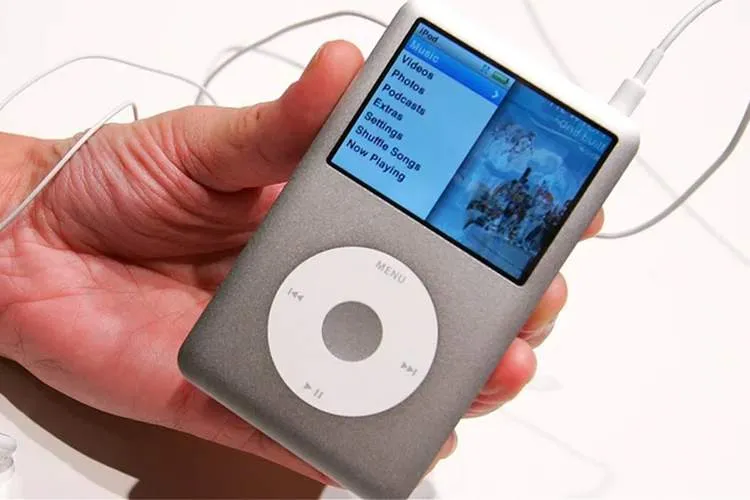
The turning point for this market came in October 2001, when Apple introduced the first iPod. A device weighing only 184 grams, with a 5-gigabyte hard drive and storage capacity for up to a thousand songs.
The iPod’s initial price was $399 and Apple promised users they could easily carry their music collection in their pocket.
The iPod quickly became more than an MP3 player. Its simple design, scroll wheel, integration with iTunes and later Apple’s digital music store unified the experience of buying, managing and listening to music.
In 2002 Apple also made the iPod available for Windows users and increased the capacity of new models.
By the mid-2000s, the iPod had become a symbol of digital culture. By 2007 about 20 percent of Americans owned a personal music player and the iPod accounted for more than 70 percent of sales in that market. Apple’s famous ads with black silhouettes and white headphones also became one of the most recognizable cultural images of that era.
But the golden age of MP3 players was short. With the growth of smartphones, a device that could be a phone, camera, browser and music player at the same time gradually replaced the MP3 player.
In 2011 iPhone sales surpassed iPod sales and the dedicated personal music player market shrank rapidly.
At the same time, the music industry moved from buying CDs and downloading files toward streaming services. The market value of personal players, which was about $21.6 billion in 2008, fell to around $613 million just four years later.
Apple finally discontinued iPod production entirely in 2022. The company had earlier retired the iPod Classic in 2014 and the Nano and Shuffle models in 2017, and the iPod touch was the last member of the iPod family.
Apple said the iPod music experience now continues on products such as the iPhone, Apple Watch, iPad and Mac.
Why has the iPod become attractive again?
Despite this official ending, the story of music players is not over. In recent years, a segment of users, especially younger people, have returned to old devices.
Searches for the phrase “MP3 player” on Google have also roughly tripled over the past year.
The reason for this comeback is largely related to digital fatigue. The iPod cannot display social networks, email, games or dozens of intrusive notifications on its screen; it only plays music. That limitation, once considered a drawback, has now become an advantage for some users.
Old iPods have also become an attractive secondary market. Well-preserved examples fetch significant prices on the secondhand market, and a group of enthusiasts upgrade them with new batteries, modern storage, USB-C and Bluetooth. Even some old models like Microsoft’s Zune have drawn renewed market attention.
Alongside vintage products, new companies and startups are trying to offer a modern version of the same idea: a device that has essential features like wireless connectivity but stays away from apps, games, advertising and streaming.
However, the comeback of MP3 players is unlikely to be as widespread as the revival of vinyl records or CDs. The main reason is that their economic and practical advantages over the smartphone are limited. Nevertheless, the growing interest in these devices shows that some users are no longer simply seeking more technology; they sometimes want less but more focused technology.
A report by The Verge shows that the iPod’s legacy is visible at this point: a device that was once built to carry as much music as possible can now serve as a symbol for stepping away from the always-connected ecosystem of smartphones.