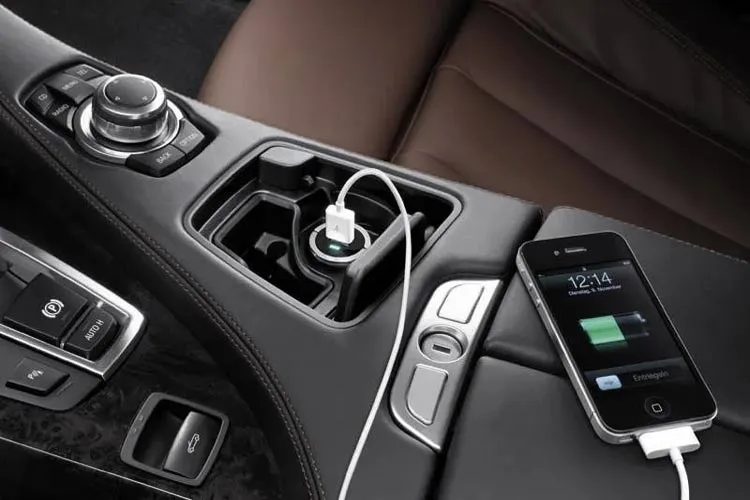
A car USB port can be a simple solution for charging your phone while driving, but in many cars the output power of these ports is not sufficient for fast charging modern phones. As a result, even if your phone and cable support fast charging technology, charging via a car USB may be very slow.
The charging speed of a device depends on factors such as voltage, current, and output power. Modern phone chargers typically operate in the 5 to 9 volt range and can provide around 2 amps or more. In contrast, the household power source supplies much more power to the charger, which is why wall chargers can provide the power needed for fast charging.
This difference is more pronounced in cars. Some car USB ports provide only about 0.5 amps of current; a power level that is very limited for fast charging new phones. Therefore, if your phone charges only very slowly when connected to a car USB, the main limitation likely comes from the port itself, not the phone’s battery or software.
USB-C has partly solved the problem
The introduction of USB-C ports in new cars has made charging somewhat better. USB-C can provide much more power for charging devices than USB-A under the right conditions, and in some cases can significantly increase charging speed.
However, the presence of a USB-C port alone does not mean fast charging is supported. Many cars still use ports with limited standards and output power. Some car USB 2.0 ports may provide only about 2.5 watts of power; while many modern phones require 20 watts or more for fast charging.
For this reason, it is natural that charging a phone via a car USB port is much slower compared to a charger that is plugged directly into a wall outlet.
How to charge your phone faster in the car?
One of the simplest ways to increase charging speed is to avoid using the car USB port and instead plug a USB-C adapter with fast charging technology into the car’s 12‑volt outlet. If the adapter and cable both support fast charging and the phone can accept that power, some adapters can provide up to about 75 watts to the device.
Of course, the number printed on the charger does not mean the phone will always charge at that power. The actual power level depends on the capabilities of the phone, adapter, and cable, and the device will only draw as much energy as it is designed to receive.
Fast charging in the car is not always the best option
Although fast charging is very useful when a phone’s battery is running low, the heat generated during fast charging can put additional long‑term stress on the battery. This becomes more important when the phone is also performing heavy tasks at the same time.
Navigation is one example of such activity. Using navigation services or Android Auto alongside fast charging can increase power consumption and heat generation. If the car is also in hot weather, the phone’s temperature may rise even more.
Therefore, while using a high‑power USB-C adapter can largely solve the slow charging problem in a car, it is better to use fast charging with caution when the phone becomes excessively hot, especially during heavy use of the device.