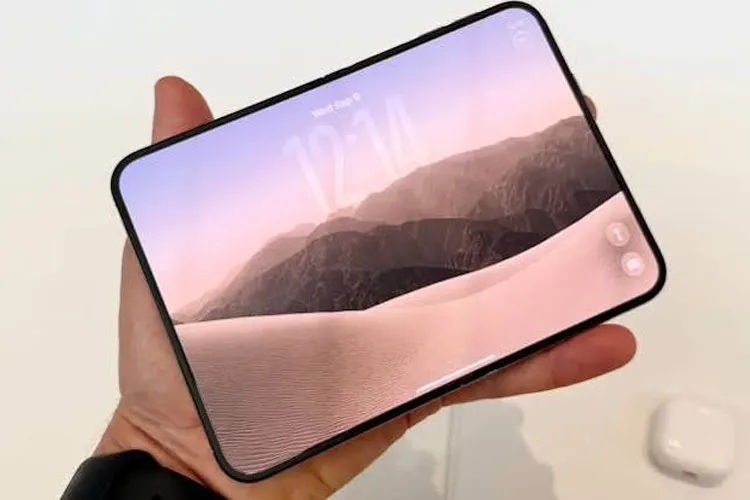
The iPhone Duo, with an inward-folding display, matte finish and software redesigned for a foldable-phone experience, is one of Apple’s most distinctive products in recent years. However, Apple’s entry into the foldable phone market has not been without compromises, and this model has lost some important hardware and software features compared with the iPhone 18 Pro.
Android foldable phones have presented users with such trade-offs for years, and it seems Apple has also been unable to eliminate all limitations caused by the foldable design. As a result, although the Duo’s large foldable display may be valuable to some users, the absence of certain features may be a sufficient reason for others to choose a regular iPhone.
iPhone Duo says goodbye to Face ID and camera controls
One of the most important differences between the iPhone Duo and traditional iPhone models is the removal of the Face ID facial recognition system. Users of this phone must use a fingerprint sensor or a passcode for authentication.
For people accustomed to unlocking their phones quickly with Face ID, this change can be noticeable; because Face ID, in addition to unlocking, is also used to confirm purchases and sign into some apps. Apple has placed a Touch ID sensor in the power button on the Duo; a method previously used in some Samsung foldables and other products.
On the other hand, the camera control located on the side of other new iPhone models is not seen on the Duo. This control allows users to change various camera settings while shooting using a two-stage shutter and a touch interface.
Of course, the absence of this button is not a major problem for all users and some may even consider it not very useful. But for users who have become dependent on iPhone camera controls, its removal can be a serious drawback.
Duo’s cameras are not on par with the iPhone 18 Pro
Another area where the iPhone Duo is limited is the camera system. This phone has a total of three cameras: two rear cameras, one front camera on the outer display and one under-display camera on the inner screen.
On the rear, the Duo is equipped with two 48-megapixel main and ultrawide cameras, but there is no periscope telephoto lens found in the iPhone 18 Pro. The new mechanical aperture and LiDAR scanner are also not present in this phone; features that can be important in professional photography, especially in certain lighting conditions.
The outer-display front camera is also 12 megapixels, whereas the iPhone 18 Pro uses an 18-megapixel front camera. In addition, the Duo lacks the sensor array required for Face ID.
The limitations are not limited to hardware. Apple has also provided professional camera controls on the iPhone 18 Pro that allow adjusting parameters such as shutter speed and aperture. These features are not available on the Duo.
Also features like ProRAW photos and spatial image and video capture offered on Apple’s pro models are not available on the Duo. Removing spatial video and photography is not very important for users who do not use the Vision Pro headset, but it can be a significant limitation for owners of that headset.
The Duo’s under-display camera is a potential weak point
One of Apple’s most interesting decisions is using an under-display camera for FaceTime on the Duo’s inner display. This technology allows Apple to have a large internal foldable display without a visible notch or hole for the camera.
However, under-display cameras have consistently faced a fundamental problem: reduced image quality. Having a layer of pixels between the lens and the subject means less light reaches the sensor and image quality drops compared with conventional cameras.
Samsung previously used such technology in some Galaxy Z Fold phones, but it could not match the quality of conventional selfie cameras. Apple has not yet released full details about the resolution of the Duo’s under-display camera.
In fact, using the name “FaceTime camera” instead of “selfie camera” may also indicate that Apple has designed this camera primarily for video calls, not for capturing high-quality selfies.
Do these limitations rule out buying the iPhone Duo?
According to Engadget, for many users these shortcomings will probably not cause a major problem. Someone who mostly takes photos for social networks and everyday use will likely not notice much difference between the Duo’s cameras and the pro model. The lack of camera controls will also not matter much to a user who never used that feature.
Even the absence of Face ID may become a new habit after a while, and the user may replace it by using the fingerprint sensor embedded in the power button.
But the situation is different for professional photographers, users interested in advanced camera features, and people who heavily rely on Face ID. This group should weigh the Duo’s limitations against its main advantage - the foldable display - before spending at least $2,000 on an iPhone Duo.
In the end, the iPhone Duo is not necessarily a better version of the iPhone 18 Pro; rather it is a product with different priorities. The user must choose between the Duo’s foldable display and unique design on one side, and the set of camera features, Face ID and pro capabilities of the iPhone 18 Pro on the other.