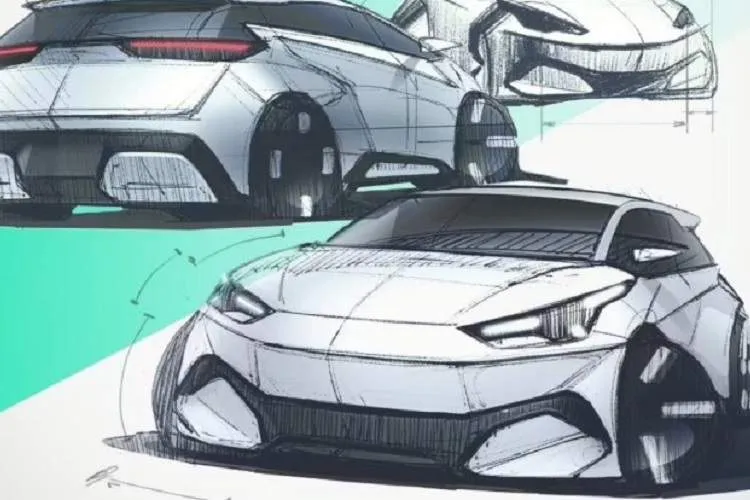
BYD is on the verge of introducing the second generation Seagull, a small city electric car that, unlike the first generation, is set to enter the market with larger dimensions and much more equipment.
According to ITNA citing Arenaev, the first-generation Seagull has sold more than 1.5 million units since its launch in 2023, but a 37.5 percent drop in sales during the first eight months of this year showed that BYD needs serious changes to maintain this model’s position in China’s competitive market.
Published official design images show the new generation will have a more aggressive and larger appearance. According to information filed with China’s Ministry of Industry and Information Technology, the vehicle’s length will reach 4205 millimeters, its width 1810 millimeters and its height 1570 millimeters. The wheelbase will also be 2650 millimeters. Therefore, the new Seagull is 425 millimeters longer than the previous generation and its wheelbase has increased by 150 millimeters.
This increase in dimensions creates more interior space. The second-generation Seagull, unlike the previous four-seater model, will be equipped with five seats and rear passenger legroom and trunk capacity will increase. As a result, this car can turn from a small city vehicle into a more practical option for families.
In the powertrain section, a 95 kW permanent magnet synchronous motor, equivalent to 127 horsepower, will replace the previous generation’s 55 kW motor. BYD’s blade-type lithium iron phosphate (LFP) battery will also be responsible for supplying energy.
One of the most important changes is the offering of a version equipped with a roof-mounted LiDAR, front, rear and side radars, and the “God’s Eye B” intelligent driving system. These equipments enable level 2+ semi-autonomous navigation in urban environments and show that advanced driving technologies have also reached economical cars.