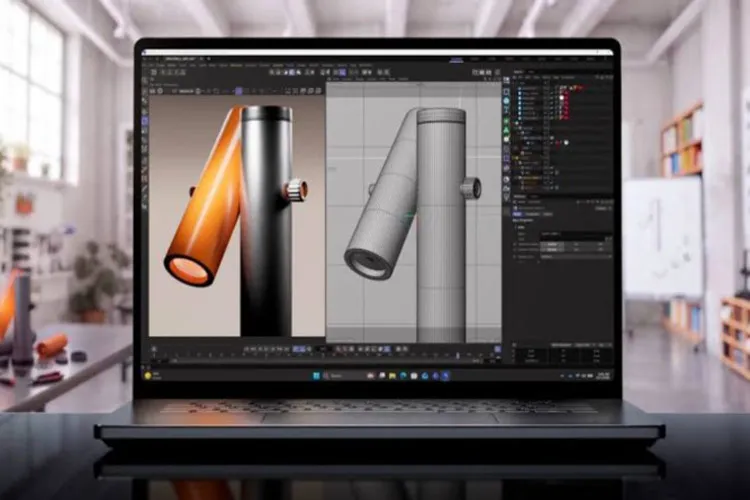
Microsoft, during an event at San Francisco’s Technology Week, introduced a new generation of Surface computers with a special focus on running AI models locally. These devices are equipped with NVIDIA’s RTX Spark chips and ship with an updated version of Windows 11 that offers new capabilities for running AI agents in an isolated environment.
NVIDIA announced in June that it is partnering with Microsoft and a number of PC makers to build devices ready to run AI and intelligent agents based on RTX Spark chips. Now the first hardware details and prices for some of these products have been revealed.
Surface Laptop Ultra with a base price of $2,600
At the event Microsoft announced the specs and price of the Surface Laptop Ultra. This laptop is offered in two main configurations, with the base model priced at $2,600 and the version equipped with a more powerful chip starting at $3,700.
With selected increased RAM and storage, the price of this device can reach $5,900. Microsoft has said the most expensive configuration is not currently available.
The main focus of these products is to provide the processing power needed to run AI models directly on the device. This means users will not necessarily need to send data to cloud services to run some AI models and tasks.
Microsoft also says this hardware will be highly capable for activities beyond AI, including content creation, video processing, and gaming.
$6,000 workstation for developers
Alongside its new laptop, Microsoft also introduced the Surface RTX Spark Dev Box; a small workstation that features the RTX Spark chip and starts at $6,000.
This device comes with Microsoft’s development tools including Visual Studio Code, GitHub Copilot CLI, Windows Subsystem for Linux (WSL), and PowerShell 7, and is primarily aimed at developers who need to run AI models locally.
Running AI models on the computer itself requires powerful hardware. In these devices, in addition to the CPU and GPU, integrated memory capacity and the cooling system are also important for running large models.
Windows 11 gets ready for the era of AI agents
One important part of these products is their software. Microsoft is shipping a revised version of Windows 11 on these devices that includes a new feature called “Execution Containers.”
This feature is designed to provide an isolated environment for running AI agents. Such an environment allows agents to perform various tasks in a controlled space while remaining separate from the user’s main system.
Satya Nadella, Microsoft’s CEO, emphasized at the event that merely having an AI model is not enough to build a powerful agent. According to him, agents need other layers such as memory, context, coordination among multiple models, and a controlled space to carry out operations.
Nadella also said Microsoft intends not to offer this infrastructure only for its own apps and that other developers will be able to run their agent-based apps on Windows. He stressed that this capability will eventually be available to all Windows 11 users.
Microsoft seeks to attract Mac developers
The high prices of these products indicate that Microsoft is initially targeting developers and professional AI users. The company is even offering up to $1,000 trade-in credit for users who swap their MacBook Pro for one of the new Surface devices.
This move comes while Apple’s Mac computers are particularly popular among developers and AI enthusiasts in Silicon Valley.
Microsoft is not the only company in this competition. Dell has also announced details of the Dell XPS 16 Creator Edition, which was introduced earlier. That device is now available for pre-order at Best Buy for $3,800 and is expected to ship in late October.
Overall, the arrival of RTX Spark–equipped computers to the market shows the competition over local AI execution has entered a new phase. Microsoft is trying to make PCs a more suitable environment for running AI agents by combining NVIDIA’s powerful hardware with new Windows 11 capabilities - an approach that could reduce some AI use cases’ dependence on cloud processing.