Astronomers say they have directly detected radio waves from a planet outside the Solar System for the first time. According to CNN, the signal is not a sign of intelligent extraterrestrial life, but indicates a very strong magnetic field on this planet.
This discovery, which is still awaiting scientific peer review, is related to repeated radio bursts whose source appears to be the exoplanet "Beta Pictoris b," located 63 light-years from Earth. This gas giant has about 12 times the mass of Jupiter and is one of three planets orbiting the young star Beta Pictoris, a star with a mass about 1.75 times that of the Sun.
Edou Berger, professor of astronomy at Harvard University and one of the paper's authors, says the radio emission is associated with processes related to the planet's magnetic field and its auroras. Planetary auroras form from the interaction of charged particles with the magnetic field and can produce radio waves as well as light.
According to Berger, the magnetic field of Beta Pictoris b is at least 200 times stronger than Jupiter's magnetic field. Jupiter's magnetic field is one of the most powerful planetary fields in the Solar System and creates a magnetosphere that extends sunward to about three million kilometers.
On Jupiter, charged particles, some of which originate from the volcanism of the moon Io, become trapped near the magnetic poles and, as the planet rotates, produce both auroras and radio waves. Astronomers call this phenomenon "auroral radio emission."
Such waves have previously been detected from Jupiter, Saturn and the Sun, and also from some stars and brown dwarfs outside the Solar System, but this is the first time researchers say the source is an exoplanet.
Previously there had been hints of radio emission from exoplanets, but it was unclear whether the waves originated from the planet itself or the host star. Joseph Callingham, associate professor at the Anton Pannekoek Institute for Astronomy at the University of Amsterdam, says the distinguishing feature of the new study is that the researchers were able to attribute the source of the emission to the planet itself and separate it from the star.
The Beta Pictoris system, at about 23 million years old, is much younger compared with the 4.5-billion-year-old Solar System. Beta Pictoris b was discovered in 2008, and the system's two other planets, Beta Pictoris c and d, were identified in 2019 and 2026, respectively.
This system is one of the most studied in the galaxy, and in addition to the three planets, at least 30 comets and a massive disk of dust and debris have been identified around its star. Part of the material in this disk is leftover from the planet-formation process.
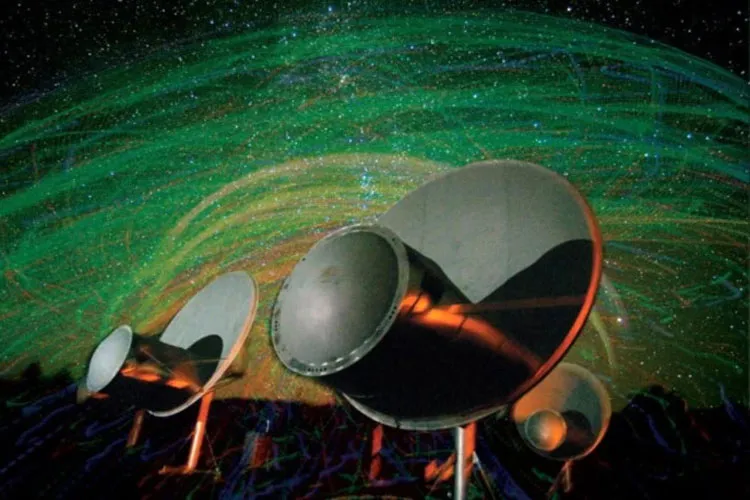
The researchers used MeerKAT, an array of 64 radio telescopes in South Africa, to detect the signal. Berger says the discovery of these waves was unexpected because astronomers had thought exoplanet magnetic fields, if present, would likely be similar to Jupiter's and their radio emissions would occur at lower frequencies.
Jonathan Nichols, professor of planetary auroras at the University of Leicester, says if the findings are confirmed, auroral radio emission could provide information about how the planet interacts with its surrounding space and reveal properties that are not measurable by other methods.