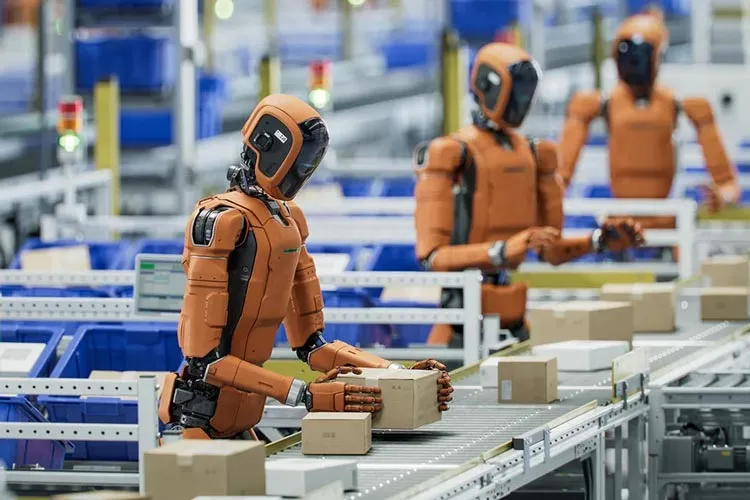
The expansion of robots and artificial intelligence in Amazon’s warehouses has posed serious questions about the future of human jobs. The company now has more than one million operational robots; but alongside increased productivity and reduced some physical injuries, concerns about work pressure, repetitive-motion injuries, and reduced need for human labor have also risen.
According to a report published by the website Ars Technica, Amazon operates the largest fleet of operational robots among companies worldwide. Despite this level of automation, human labor still constitutes an important part of this e-commerce giant’s operations; so much so that, according to the company’s 2025 annual report, its number of full-time and part-time employees exceeded 1,500,000.
The spread of robots in Amazon’s warehouses is not limited to replacing humans for physical tasks. The company is developing systems that, with the help of artificial intelligence, identify a wide range of products and enable the movement of items that were difficult for earlier-generation robots to handle.
How are robots changing Amazon’s warehouse work?
Amazon’s mobile robots transport shelves containing goods to workstations, and robotic arms are used in processes such as picking, sorting, and loading packages into delivery trucks. The aim of these technologies is to increase order-processing speed and reduce the need for employees to perform heavy and repetitive tasks.
One example of these technologies is the Vulcan robot, which uses computer vision and force sensors. This combination allows the robot to detect the amount of force applied when picking up and moving goods and to place items on shelves with greater precision.
According to Amazon, this technology can make access to items located in difficult parts of shelves easier and reduce the need for workers to use ladders or bend repeatedly.
Amazon also intends to increase the production capacity of its robotic arms and is pursuing the establishment of new factories to develop these technologies. These actions are part of the company’s strategy to further automate warehouses, increase productivity, and speed up order deliveries.
Increased productivity at the cost of physical injuries?
Despite the benefits of automation, the spread of robots does not necessarily mean an across-the-board improvement in working conditions. A 2025 study published in the ILR Review presents a mixed picture of the impact of robots on the health of Amazon warehouse workers.
According to this study, warehouses equipped with robots experienced a 40 percent reduction in severe injuries compared to traditional warehouses; however, at the same time, the rate of less severe injuries related to work pressure and repetitive motions increased by 77 percent.
Researchers believe that increased operational speed may be one factor in this contradiction. Robots move goods faster, but human workers still have to keep pace with the set work tempo. As a result, although some heavy and difficult tasks are assigned to machines, the pressure from rapidly repeating other tasks may increase.
In other words, automation can reduce the risk of some physical injuries, but if the work speed and volume of human tasks are not adjusted to workers’ capacities, other problems may arise.
Amazon has rejected some criticisms about workplace safety, saying that employee injury metrics have improved in recent years. The company also emphasizes that robots are designed to assist workers in performing dangerous tasks.
Is Amazon preparing to cut hundreds of thousands of jobs?
Concerns about the spread of robots are not limited to working conditions; the possibility of reduced need for human labor has also become a central topic in discussions about the company’s future.
The New York Times published a report in October 2025 about internal Amazon documents that mentioned the potential reduction in the company’s need for U.S. workers in coming years.
According to figures in those documents, the expansion of automation could have reduced the need for about 160,000 workers by 2027 and about 600,000 by 2033.
However, these figures reflect projections in internal documents and do not constitute an official announcement of plans to lay off that number of employees. They should also not be equated with the number of jobs that have actually been eliminated so far.
On the other hand, Amazon argues that the development of robotic technologies can create new job opportunities in areas such as engineering, equipment maintenance, and management of automated systems. The company also believes that growth in its business activities has led to the creation of new job opportunities.
The future of work: human–machine collaboration or replacement of human labor?
Amazon’s experience shows that the impact of automation on the labor market cannot be measured solely by the number of robots or employees. Robots can take on heavy and dangerous tasks, but how work is organized, the speed expected of employees, and the level of oversight of workplace conditions also play important roles in determining the outcomes of this technology.
On one hand, the development of robotics can increase warehouse productivity and reduce the likelihood of some serious injuries. On the other hand, if increased operational speed leads to greater pressure on workers, some of the safety benefits of this technology may be undermined.
Regarding employment, it is still not possible to say definitively how many jobs the development of robots will ultimately eliminate or create. What is clear is Amazon’s movement toward broader automation; a path that can change the mix of jobs the company needs and increase demand for certain technical skills.
Ultimately, the main question is not only whether robots will replace humans; it is whether increased productivity will lead to reduced work pressure and improved conditions for workers, or whether humans will be forced to compete with the speed of machines.