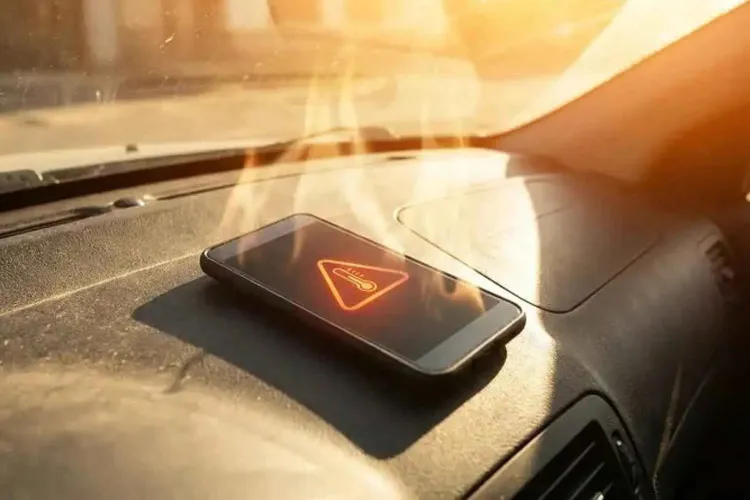
Leaving a phone, laptop or power bank in a parked car under sunlight, even for a short time, can endanger the battery and their internal components. Experts warn that a rapid rise in cabin temperature may lead to reduced battery life, device malfunction and, in severe cases, more serious damage.
Placing a phone or laptop in a parked car, especially when the device is turned off or kept inside a bag, may seem harmless. However, the temperature inside a car can rise significantly in a short time and create conditions that are unsuitable for electronic equipment.
The main reason for this situation is sunlight entering through the car windows and much of the heat remaining inside the cabin. For this reason, the inside temperature of a car can be much higher than the outside air temperature.
Under such conditions, even devices that are not directly under sunlight may be exposed to temperatures higher than the ranges recommended by manufacturers for use or storage.
How does heat damage a phone battery?
Lithium-ion batteries are among the components most sensitive to heat in electronic equipment. These batteries are used in smartphones, laptops, smartwatches, wireless earbuds and many portable devices.
Repeated exposure to high temperatures can accelerate chemical reactions inside the battery. The result of this process is a reduced ability of the battery to hold charge and a shorter useful life.
In extreme heat, there is also a possibility of battery damage or swelling, and in acute cases, a serious malfunction may occur.
Of course, placing a phone in a hot car once does not necessarily mean definite damage to the battery; but repeating this situation increases the likelihood of problems, especially if the device is exposed to direct sunlight or near a car window.
Sudden shutdown of the phone due to temperature rise
Heat damage is not limited to the battery. Modern smartphones are usually equipped with thermal management systems that act to protect components when internal temperatures rise excessively.
These systems may reduce processor speed or screen brightness and temporarily disable some features. In some cases the phone displays a temperature warning message, stops charging, or automatically shuts down until it cools down.
Nevertheless, thermal protection systems cannot eliminate all potential damage caused by prolonged or repeated exposure to heat.
The display, adhesives used in device construction and plastic components may also be affected by extreme temperatures. Some damages do not appear immediately and may later manifest as functional issues.
Laptops, cameras and headphones are also at risk
The notion that larger electronic equipment is more heat-resistant is not always true. In addition to the battery, laptops have sensitive electronic components whose performance and efficiency can be affected by temperature increases.
Digital cameras may also face problems with the battery, display and some optical components due to extreme heat or frequent temperature changes. Tablets, wireless headphones, power banks and portable navigation devices are not exempt from this risk.
The likelihood of damage increases when these items remain in the car for several hours or are placed in closed compartments where heat cannot escape.
Putting a phone on the dashboard or in a bag is not a reliable solution
One common belief is that placing a phone on the dashboard, in the car’s internal compartments or in a closed bag can protect it from heat damage. Although these methods may reduce direct exposure to sunlight, they do not prevent the surrounding temperature from rising.
Heat inside the cabin can still transfer into the bag or compartment and raise the device’s temperature. Turning off the phone also does not provide complete protection, because the battery and other internal components are affected by ambient temperature even when the device is off.
This issue becomes more important when storing multiple devices in the car at the same time, because a phone, laptop and power bank may have different temperature ranges for use and storage.
What to do to prevent heat damage to devices?
The most effective preventive measure is to avoid leaving electronic devices in a parked car under sunlight. It is better to take your phone, laptop and power bank with you when leaving the car, especially on hot days.
If you notice your phone’s temperature has risen above normal, the following actions can help reduce the risk of damage:
1. Stop using the device. If the phone is charging, unplug it to prevent additional heat generation.
2. Move the device to a cooler environment. Place the phone in a shaded, well-ventilated area and allow its temperature to decrease gradually.
3. Avoid sudden cooling. Putting the phone in a refrigerator or in front of a strong cooling source is not recommended, because sudden temperature changes can cause other problems, including condensation-related moisture.
4. Do not charge the phone until it cools down. Charging a device that is too hot can place additional thermal stress on the battery.
5. Take signs of battery damage seriously. If the battery is swollen, there is an unusual smell from the device or its body is deformed, stop using and charging the device and seek help from an authorized service center.
Ultimately, the danger of heat inside parked cars is not limited to reduced phone performance or shortened battery life, but can also affect the safety of internal device components.
Although new electronic devices are equipped with thermal protection features, these technologies do not guarantee that a device will not be damaged under extreme heat. Therefore, taking electronic devices with you when leaving the car is the safest way to reduce these risks.