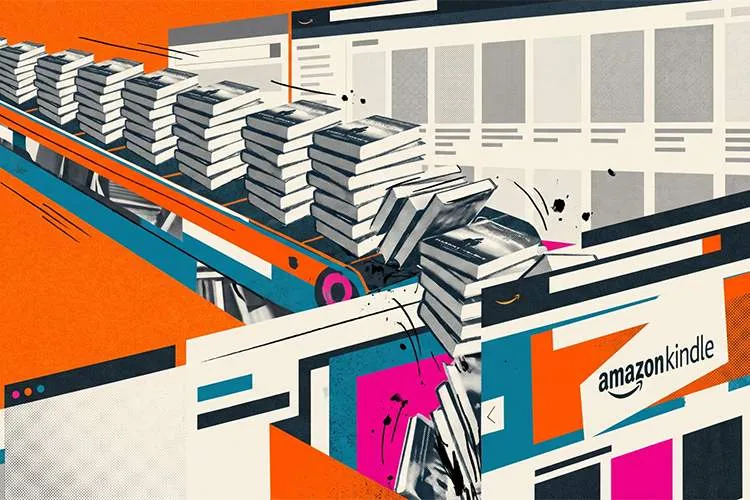
Generative artificial intelligence, by dramatically reducing the cost of producing text, has confronted the book market with a wave of new titles.
A new study shows this supply increase has not been limited to low-selling books and, by intensifying competition for sales, visibility, and top ranks, has reduced per-title earnings for many human-authored works as well.
Researchers recently examined 14,419 independently published fiction books (books published directly by authors without a publisher) on Amazon released between January 2023 and March 2026 by analyzing the full text of the works and daily sales data.
Books for which more than 25 percent of the text was identified as AI-generated made up about 20 percent, but their share of sales was 12.1 percent and of revenue 11.3 percent. In contrast, works without AI-identified text accounted for 62.9 percent of the total and 72.5 percent of revenue.
The effect of this saturation has reached works without AI-identified text as well. Revenue per book fell in seven of the eight genres examined; only in the fantasy, supernatural, and horror genre did per-title revenue for non-AI works increase. The researchers call this pattern "thinning," although they emphasize their study is observational and does not definitively prove causation.
AI books have reached top ranks too
The presence of works with substantial AI-generated content in Amazon's top ranks has also increased. The share of these books among new titles entering the top 25 list rose from nearly zero at the start of the study period to about 31 percent.
The study also shows some producers sped up publication after releasing their first work with substantial AI content. This indicates the main advantage of generative production for the self-publishing market: the ability to produce large numbers of titles at very low marginal cost.
Concern about similarity to existing works
Among the 50 highest-earning books with substantial AI content, rare phrases that appear in a limited number of Google Books entries covered about 45 percent of the text; by contrast, this share was 37.7 percent for the top 50 books without AI-identified text.
The researchers stress, however, that this finding alone does not prove theft or direct copying, but it may be an indicator of these works' greater reliance on linguistic patterns present in already-published books.
It's not just the quality of AI books
The importance of the study is that the economic effect of AI should not be judged only by the quality or sales of individual produced books. Even if many of these works have limited sales, their mass production can greatly increase the number of competitors and thereby reduce the revenue share of human authors.
This issue is particularly important in the digital market, because publishing on platforms like Kindle Direct Publishing has a low marginal cost and search and ranking algorithms play a significant role in audience access to works.
Amazon has not banned the use of AI-generated content, but asks publishers to disclose AI-generated content during the publishing process.
Overall, the research indicates AI may transform the publishing industry not necessarily by directly replacing authors, but by sharply increasing supply volume and thinning the market.
The researchers consider these findings observational and emphasize that further studies are needed to prove causation.