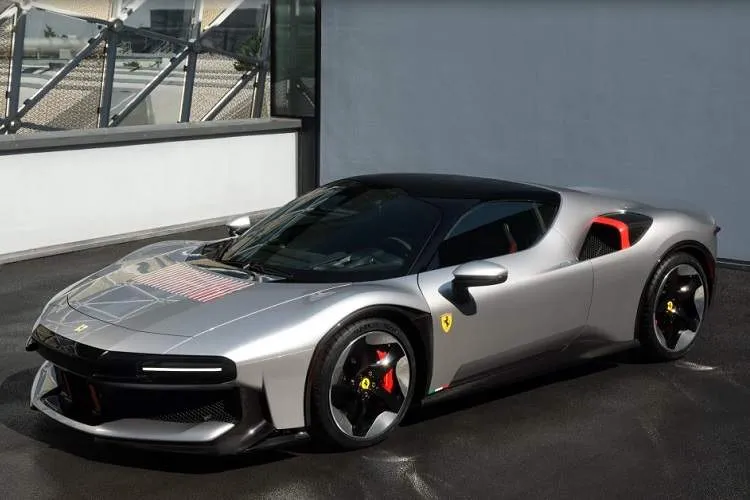
Ferrari unveiled a one-off car named CZ26 at the Monterey event, whose appearance bears a strong resemblance to the company’s first electric car, the Ferrari Luce. But beneath this modern design sits the same powertrain as the SF90 Stradale; a plug-in hybrid powerplant with a twin-turbo V8 engine, a 7.9 kWh battery and a 25-kilometer all-electric range.
According to ITNA quoting Electrek, simply put, the CZ26 is a combination of Luce’s design language and the SF90’s mechanical heart; something like a child that would exist if Luce and the SF90 had a offspring.
What has Ferrari built in the CZ26?
The CZ26 is the result of Ferrari’s Special Projects program; a service that produces fully bespoke, one-off cars for select clients. This car was designed by Ferrari’s design studio under the direction of Flavio Manzoni and for an American client. Ferrari says producing such projects from concept to final product takes about two years.
Technically, Ferrari has not made any significant changes to the powertrain. The CZ26 retains the same specifications as the SF90 Stradale: a 3,990 cc twin-turbo V8 engine with 797 metric horsepower (cv), electric motors with a combined output of 162 kW and a 7.9 kWh battery. The car’s top speed reaches 328 km/h and its 0–100 km/h acceleration is only 2.5 seconds.
According to Ferrari’s official specifications, the CZ26’s CO2 emissions in the WLTP cycle are 154 grams per kilometer. The car also has a 68-liter fuel tank and the ability to travel 25 kilometers on pure electric power.
Almost all body panels above the chassis mounting points are completely new. The CZ26 features a two-volume form, a central capsule-like section, muscular fenders, suspended taillights, new intakes and air channels, a redesigned spoiler and diffuser, and Argento Veloce silver paint with a liquid-like finish.
Luce’s face on a gasoline car
The front end bears the greatest resemblance to the Luce. Ferrari has used a full-width functional grille with very slim lights that have a “hidden” feel. Sensors and brake cooling channels are also integrated into this same continuous strip.
This design language is the same as seen on the Ferrari Luce: horizontal emphasis, hidden lights in a full-width graphic, and simple surfaces from which functional elements emerge. Even the black roof and pillars make the cabin appear as a separate capsule on the body.
Ferrari has stated the CZ26’s design was also inspired by iconic examples of Italian industrial design from the 1970s.
The Luce faced negative reactions when unveiled in Rome, and even Luca di Montezemolo, former Ferrari chairman, criticized its design. Nevertheless, Ferrari did not back down and sold the entire roughly 500-unit allocation of the Luce for 2026 at a price of €550,000 in less than two months.
Now part of that same controversial design language is seen on a mid-engined supercar; a development that indicates Ferrari apparently has no intention of retreating from its new design direction.