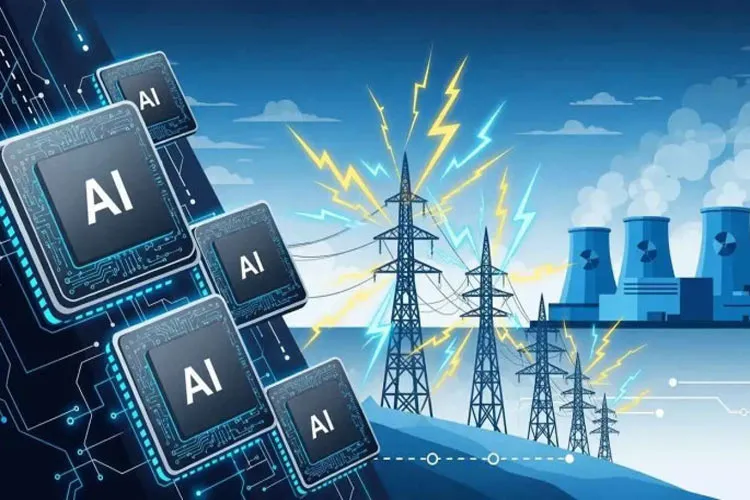
The rapid growth of artificial intelligence no longer challenges only tech companies and chipmakers; power grids are now faced with an unprecedented wave of energy demand. The data centers responsible for training and running AI models require vast amounts of electricity and operate around the clock; a factor that calls into question whether current infrastructure can meet this growth.
How much electricity do AI data centers consume?
AI-equipped data centers differ significantly from traditional data centers in the type and amount of energy they consume. These facilities rely on large numbers of advanced processors that consume considerable power when training or running AI models.
Of course, energy consumption is not limited to processors. Advanced cooling systems, networking equipment, storage systems, and other supporting infrastructure must also remain continuously active.
As tech companies increase investment in training and running AI models, the size of data centers is also growing. As a result, a very large volume of electricity demand may become concentrated in a geographic area, putting significant strain on the local grid.
Building more power plants is not the whole story
At first glance, the solution to increased data center consumption appears simple: build more power plants. But the problem is not just how much electricity is produced; delivering that energy to where it is consumed also matters.
Even if a country can sufficiently increase its power generation capacity, the existing transmission network may not be able to transfer that volume of energy to data centers.
Large data centers require high-capacity transmission lines, substations, switching equipment, and infrastructure that can manage heavy, steady loads. Developing such infrastructure typically takes years, while tech companies can build and commission new data centers at a much faster pace.
Thus, a widening gap has formed between the growth rate of the AI industry and the pace of energy infrastructure development.
Nuclear, gas, and renewables in the spotlight
Tech companies and data center operators, in response to this challenge, are seeking a mix of reliable energy sources. Nuclear power, gas-fired plants, and renewables alongside energy storage technologies are among the options receiving increased attention.
Some companies are also pursuing building data centers close to power generation sources. Such an approach can reduce the strain on transmission networks and shorten the path of energy supply to data centers.
Signing long-term power purchase agreements is another measure that can help tech companies secure stable energy supply.
A data center can consume as much electricity as a city
The scale of AI data centers’ energy consumption becomes clearer when compared to a building or a city’s electricity usage.
An ordinary home requires only a few kilowatts of power, while a large data center can need tens of megawatts. For massive data centers designed specifically for AI processing, this amount can reach hundreds of megawatts.
For this reason, the energy consumption of such facilities is no longer comparable to a single tech building and in some cases approaches the electricity use of a small city.
According to Eitna, this extensive consumption is not only to power processors. Cooling systems, storage equipment, communication networks, and electrical infrastructure also require continuous energy.
Consequently, building a massive data center can represent an addition of a very large electrical load to the local grid; a matter that has increased concerns about the grid’s capacity to keep pace with the AI boom.
Electricity: the next bottleneck for AI development
Power plants and grids can ultimately align themselves with AI growth, but achieving this requires heavy investments and long-term planning.
The challenge ahead is not merely producing more electricity. Power networks, parts of which are decades old, must be upgraded and modernized to manage the heavy, stable, and growing loads of data centers.
From this perspective, access to electricity can become one of the most important constraints on developing new data centers. While competition among tech companies has so far focused more on advanced chips, processors, and computing capacity, another crucial competition is emerging: which company can guarantee enough energy to power the computing needs of the AI era?
In fact, the future expansion of AI does not depend solely on computing power and model improvements; the capacity of power grids and the speed of energy infrastructure development can also determine how quickly the next wave of data centers is built and brought online.