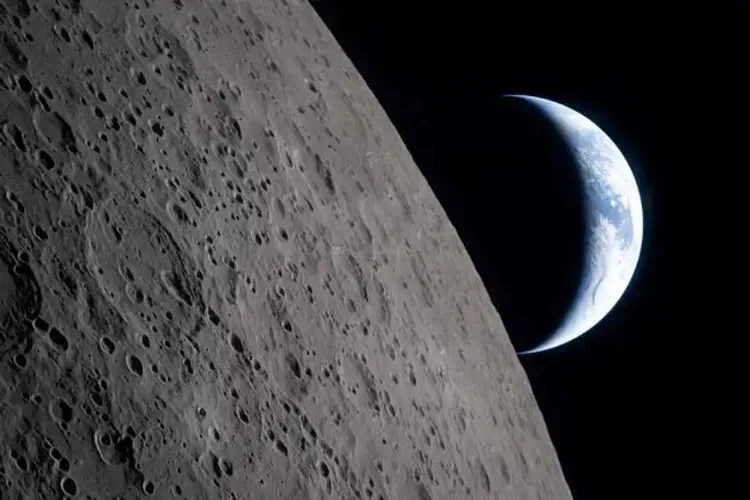
At first glance the Moon appears to be a completely inhospitable environment for life; but a new study by NASA scientists shows that some terrestrial microorganisms may, under certain conditions, survive on the lunar surface for weeks to months. This finding could raise concerns about the unintentional transfer of Earth life to the Moon during exploratory missions.
Astronauts need special suits to operate in the lunar environment and spacecraft are also designed with a range of protective measures, because the lunar surface lacks breathable air and is exposed to extreme temperature fluctuations, space radiation, and energetic particles. Nevertheless, microbes and other terrestrial microorganisms can be unintentionally brought into extraterrestrial environments by astronauts and equipment.
Researchers at the National Aeronautics and Space Administration (NASA) in a new study examined the resilience of five types of fungi and bacteria against conditions similar to the lunar environment. Results showed that some of these microorganisms, under specific conditions - including permanently shadowed regions and certain times of the year - have the ability to survive for several weeks to several months.
According to Prabal Saxena, a planetary scientist at NASA's Goddard Space Flight Center in Maryland and the lead author of this study, the likelihood of microorganism survival is not the same across all parts of the Moon and depends on factors such as location and environmental conditions.
Fungi were more resilient than bacteria
In this experiment, two types of fungi showed greater resilience compared with three types of bacteria. One of these fungi was Aspergillus, including species known as "black Aspergillus," which commonly grow in warm and humid environments such as bathrooms and air conditioning systems.
This fungus had previously been identified on the International Space Station as well. Experiments conducted have shown that Aspergillus can even survive for a time outside the space station and in Earth orbit.
Researchers also examined several species of Fusarium; a group of common soil fungi that are widespread in terrestrial environments.
Saxena said about the results that Aspergillus showed the greatest adaptability for surviving in the Moon's polar regions and Fusarium also had notable resilience, although its performance was not as strong as Aspergillus.
Bacteria were less resistant to ultraviolet light
The three bacterial groups examined included radiation-resistant microorganisms, Staphylococcus aureus, and a group of rod-shaped bacteria found in environments such as soil and plants as well as the human gastrointestinal tract.
According to Saxena, the bacteria studied had lower tolerance to ultraviolet rays compared with the fungi, and therefore their survival rates were also lower.
Nevertheless, the study's findings indicate that even the harsh lunar environment is not necessarily sufficient to rapidly eliminate all terrestrial microorganisms. This issue could be important for planning future missions and how to protect lunar environments.
Concern about lunar biological contamination
One of the most significant implications of this finding is increased concern about the unintentional transfer of terrestrial microbes to the Moon. Astronauts and exploration equipment may carry microorganisms that, if they reach suitable environments, can survive for a time.
Researchers have warned that such contamination could affect potential lunar resources, including deposits of water ice in some regions of the Moon's surface; resources that could be vitally important for astronauts in future missions.
On the other hand, biological contamination can also complicate scientific research about the Moon. The introduction of Earth microbes into lunar environments could make it difficult to determine whether a biosignature has a natural lunar origin or was transferred from Earth.
This study, published a few days ago in the journal Science Advances, did not investigate whether lunar environmental conditions could induce mutations in these microorganisms or increase the likelihood of their becoming more pathogenic. Therefore, important questions remain unanswered about the long-term biological consequences of terrestrial microbes surviving on the Moon.
With the increase in lunar exploration programs and the gradual return of humans to the surface of the Moon, the new findings show that planetary protection is no longer limited to preventing the possible transfer of alien life to Earth; preventing the transfer of Earth life to other celestial bodies has also become one of the major challenges of space exploration.