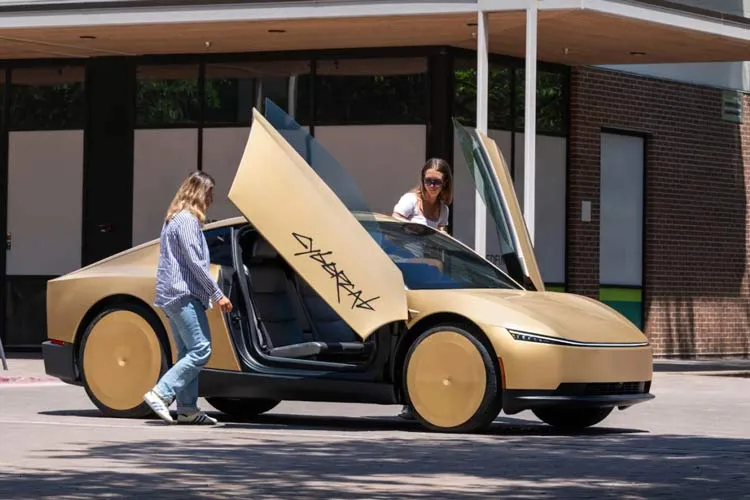
A private unveiling event for Tesla’s “Cybercab” was held and concluded; an event that, unlike the loud, livestreamed ceremonies the company usually arranges for its products, was conducted very simply and quietly. This approach can be seen as an unexpected choice for introducing a product that Elon Musk, Tesla’s CEO, has spent years investing in developing.
According to published reports, it is not even clear whether Musk personally spoke at the event, and the main presentation lasted only about fifteen minutes.
The promise Tesla has made for Cybercab is very ambitious: a fully autonomous vehicle that, relying only on cameras and artificial intelligence, travels without the need for lidar sensors, and at a price far lower than Waymo’s self-driving vehicles. However, Tesla has so far released limited technical details about this product. Some of this information appears in PDF files released by the company on Thursday (local time) and in updated terms of service for the Robotaxi app, and some has been provided only to a limited group of the brand’s most ardent fans.
Tesla now faces an important challenge: it must prove the safety of these vehicles to the public, to local authorities, and to the National Highway Traffic Safety Administration (NHTSA), which had previously opened investigations into Cybercab’s deployment process.
Below, we review some of the most notable newly released details about this vehicle:
Ban on Carrying Young Children
One of the most interesting points raised in the Cybercab documents is that Tesla “currently” does not allow people under thirteen years old to ride in the vehicle.
According to these documents, minors aged eight to seventeen are allowed to ride in Tesla Model Y SUVs operating under the Robotaxi brand, and Tesla has provided specific guidelines for using child seats in both types of vehicles.
Another notable point is that Cybercab lacks standard LATCH anchors for installing child seats and only allows attachment using a regular seat belt. Tesla executives, including Musk, have repeatedly emphasized the company’s focus on removing unnecessary parts to reduce production costs; nevertheless, removing child seat anchors was an unexpected decision, especially given Musk’s frequent emphasis on the importance of increasing birth rates.
Tesla states that all children under eighteen must be accompanied by an adult in both vehicles; nevertheless, the company’s caution about carrying very young children in Cybercab has not yet been clearly explained.
Safety Protocol in a Crash
Although the main goal of self-driving cars is to prevent crashes, even today’s most advanced vehicles can ultimately be involved in accidents.
According to the published documents, in the event of a crash, Cybercab automatically executes a set of safety actions: airbags deploy, doors unlock, hazard lights and interior lighting activate, the high-voltage battery is disabled, windows move to a “vent” position, the vehicle brakes and stops, and the vehicle’s infotainment system establishes two-way communication with Tesla’s driver support team.
The automatic unlocking of doors is noteworthy, because Tesla has previously faced serious criticism for relying on electronic door locks, both in its domestic market, the United States, and in its largest international market, China. Just last month, Tesla and several other automakers agreed to recall nearly three million vehicles in China amid investigations into electronic door locks that might trap occupants after a crash.
Manual Door-Opening Mechanism
In this context, another criticism leveled at Tesla has been the difficulty of locating manual interior door locks in emergencies; locks that are especially important given the company’s reliance on electronic door open/close systems (whether via a button or smartphone).
Cybercab also uses an electronic locking system that allows doors to open automatically at the start and end of a trip. In addition, a small button is provided on the exterior of the vehicle to open the doors. However, Tesla says that inside the vehicle, the manual release button is located in a clearly visible and designated spot on the handle of each door.
Brake-by-Wire System
Tesla uses Brake-by-Wire technology in Cybercab which, like many of the company’s other decisions, was primarily designed to reduce production costs. In this technology, instead of using a hydraulic system that transmits brake pressure through fluid and connecting lines, electronic actuators are used to control the brake calipers.
Musk wrote in one of his posts that using electronic brakes eliminates the complexities of a hydraulic system and removes the need for piping throughout the vehicle body.
It is worth noting that Tesla previously, as the first major automaker, used a Steer-by-Wire system in the Cybertruck, removing the physical connection between the steering wheel and the front wheels.
Other Technical Points
According to the released documents, Cybercab windows “currently cannot fully open,” without Tesla giving a specific reason for this limitation.
On the other hand, according to automotive influencer Jeremy Judkins, the USB-C charging ports installed in Cybercab provide ninety watts of output; a figure that is roughly four times the usual power of charging ports in other vehicles.