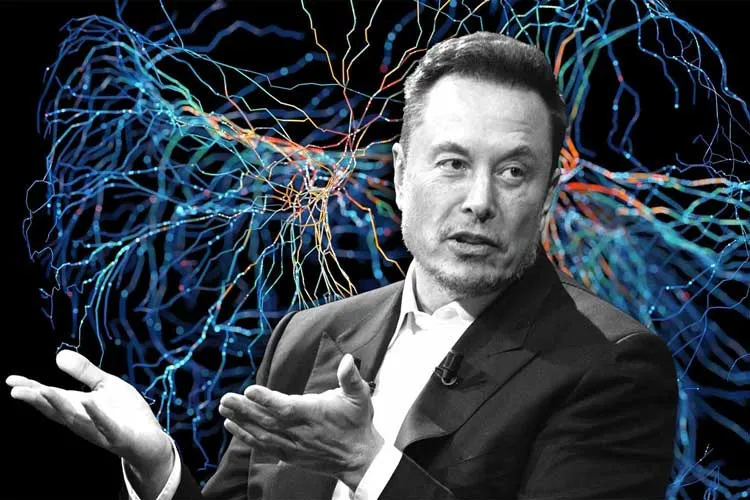
Elon Musk, in remarks about the future of human interaction with artificial intelligence, has argued that even if AI systems are designed to help humans as much as possible, a fundamental limitation will remain: the speed of human-machine communication.
According to Musk, computers can process and transmit information at very high speeds, while humans' capacity to receive and transmit information to machines is much lower. In this context he has mentioned figures on the order of one trillion bits per second for computer-to-computer communication and less than 100 bits per second for human-to-machine communication.
These numbers, especially regarding human-computer communication capacity, should be regarded as Musk's estimates and claims rather than a definitive scientific standard for the human brain's capacity. Nevertheless, the issue he raises relates to one of the main research topics in the field of brain–computer interfaces (BCI): how can neural signals be converted into digital commands with greater speed and accuracy?
Why does Musk consider a brain chip important?
Musk believes any technology that can increase the rate of information exchange between humans and computers can also improve human–AI interaction. Describing the gap between machine and human capability, he has said that without such technologies, communication with a very powerful AI system might be like "talking to a tree."
The logic of this view is that even if AI can process information at very high speeds, humans still have to interact with it through traditional methods like keyboards, displays, voice, or hand movements.
A brain–computer interface can create a different path. In this technology, neural activity is recorded and then decoded by algorithms so that the user's intent or command is converted into a digital action.
What has Neuralink done so far?
Neuralink was founded in 2016 with the aim of developing brain–computer interface technology. The company received approval to begin its first human study in 2023, and its first human implant was performed in January 2024. Neuralink says the primary goal of the technology is to help people with severe paralysis control digital devices using brain signals.
Neuralink's N1 implant uses 1,024 electrodes on 64 flexible threads to record neural activity. These signals are transmitted wirelessly and the company's software converts them into commands usable by a computer.
In the experiments conducted, the company has stated that implanted users were able to control a computer using their thoughts and perform tasks such as controlling a cursor, playing video games, and using various software.
From controlling a computer to converting thought into speech
Neuralink's explored applications have now gone beyond simple computer control. The company has a separate clinical study aimed at decoding words from brain activity for people with severe speech impairment.
Neuralink explains that the goal of this technology is to convert neural signals related to speech intent into text or even direct speech. This pathway could be especially important for people who have lost the ability to speak due to diseases like ALS, stroke, or spinal cord injury.
Will a brain chip really become necessary for AI?
At present, such a conclusion is unproven. Neuralink's current applications are mainly within the framework of clinical trials and assistive technologies for people with neurological disabilities, and the company itself presents these technologies as still under investigation and development.
However, if brain–computer interfaces in the future can decode neural information with much greater speed, accuracy, and reliability, the way humans interact with computers might change. In such a scenario, instead of typing a command or speaking it aloud, part of the user's intent could be extracted directly from brain activity.
Neuralink has also described its long-term vision of building a general, high-bandwidth interface between the brain and digital technology. Nevertheless, the gap between this vision and a commercial, widespread technology remains significant, and safety, accuracy, implant durability, and the ability to reliably decode brain signals are among the most important challenges ahead.
As a result, Musk's idea about the necessity of brain chips for human–AI communication is more of a forward-looking vision than a proven technological requirement. Neuralink's current trajectory shows the technology is initially being developed for medical applications and to help restore the ability to interact with digital tools; but success in these trials could pave the way to explore broader applications of brain–computer interfaces in the future.