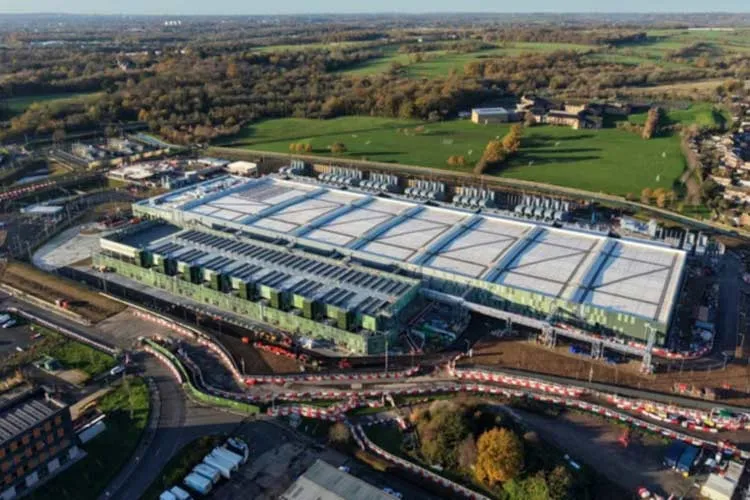
AI data centers have become one of the most controversial topics in the tech world. These centers are an integral part of running AI applications such as ChatGPT and Google Gemini, but at the same time they have attracted attention because of their environmental and social consequences. Noise from their operation can make living near a data center difficult, and the carbon emissions of some data centers may exceed the emissions of a small country.
These problems have become more visible with the rapid expansion of data centers alongside the AI boom, but the existence of data centers is not a new issue. Data centers have existed for decades and their history goes back to the early days of computing. The first data centers were actually rooms that housed large computer machines, and these centers evolved over time along with advances in computers.
The definition of a data center is simple: a physical space that houses computing infrastructure and operates around the clock. These spaces are equipped with powerful generators so that computer operations can continue even if the local power grid goes down. They also have high-capacity internet connections that allow far greater data transfer than ordinary routers.
Data centers are used to store, process, and transfer all kinds of data, from emails and credit card transactions to today’s chatbot messages. Every time you store data in the cloud or use a cybersecurity app to protect your information, you are in fact using some form of data center service. But how did data centers take shape and become an integral part of digital life?
A brief history of data centers
The first data centers emerged alongside the advent of early computers in the 1950s and 1960s. The earliest examples of data centers were mainframes: very large computers capable of performing complex calculations and typically requiring an entire room for their upkeep.
At that time the concept of computer networks as we know them today did not yet exist. For that reason, each mainframe can be considered a kind of independent, standalone data center. These systems grew larger in the 1970s and 1980s, but the next major transformation came with the rise of microprocessors and the emergence of the internet in the 1990s.
In the same period, virtualization technology also appeared. This technology made it possible to use a single physical device to create multiple virtual machines, including servers and networks. In the early 2000s, virtual servers became increasingly available to users at rising prices, and demand for data centers quickly increased.
Virtualization helped form centralized computing networks; so that today many devices rely on a limited number of data centers to perform various activities.
Each stage of data center history has been accompanied by a rapid increase in demand. First the microprocessor boom, then the expansion of cloud computing, and now the AI boom-each created more demand for data center capacity. With this growing demand, data centers have also transformed from single rooms and buildings into vast complexes.
For decades data centers operated largely out of the public eye, but their massive scale in recent years has made them impossible to ignore.
The different types of data centers in today’s world
Even in the AI boom era, not all data centers are built to run AI applications. Data centers cover diverse needs, and accordingly, different types have been created for various purposes.
The Telecommunications Industry Association (TIA) divides data centers into four tiers. All of these tiers provide basic services such as round-the-clock power and cooling systems. However, Tier 1 data centers cover only these basic needs, while higher tiers, up to Tier 4, offer more facilities and infrastructure to increase resilience and cope with disruptions. At the highest level, fully isolated power systems can allow the data center to continue operating in the face of disruptions.
Within these categorizations, there are also data centers with specialized applications. Telecommunication data centers are used to support communication networks such as the internet and mobile services. Enterprise data centers belong to organizations like banks and hospitals and are usually managed internally. These centers handle sensitive data that require a higher level of security.
Cryptocurrency mining data centers are another type of data center.
Alongside these, AI data centers are the newest member of the data center family. These centers themselves are divided into several groups, including AI training data centers and AI inference data centers.
AI training data centers, as their name suggests, are used to train AI models using massive volumes of data. In contrast, AI inference data centers support active AI models and respond to growing user demand.