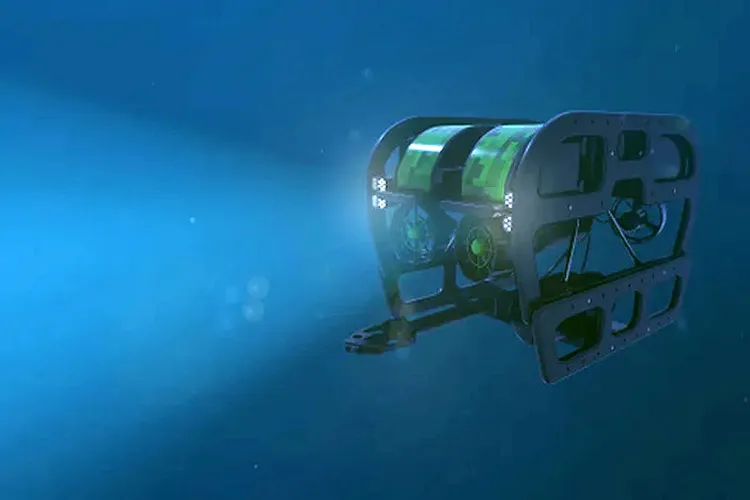
The ocean remains one of the least explored parts of planet Earth. Although satellite data provide an overall image of the ocean floor, real details are revealed only by direct mapping and technologies such as multibeam sonar. According to NOAA data, as of April 2026 only 28.7 percent of the global ocean floor has been mapped with modern high-resolution technologies.
In this context, autonomous underwater vehicles and drones can bring sonar closer to the seabed and provide researchers with more precise information. But there is an unexpected problem: the same curved, smooth housing that protects the drone’s equipment and makes its movement through water smoother can refract sonar sound waves and distort the final image.
Where does the problem come from?
Sonar works by sending sound waves and receiving their echoes from objects and the seabed. The more focused the sound beam, the greater the ability to detect objects in its path. But when these waves pass through a curved dome, the wavefront is deformed and part of the acoustic energy is scattered in unwanted directions.
Instead of adding complex electronic systems and heavy processing algorithms, the researchers turned to a purely physical solution: an acoustic lens.
An index-gradient lens made of silicon and tungsten
The research team built a gradient-index lens composed of concentric silicon rings. Different amounts of tungsten particles were used in the construction of these rings. Changing the material composition alters the speed of sound propagation in different parts of the lens and, as a result, the shape of the sound wave is changed in a controlled manner.
The researchers first calculated the amount of distortion caused by the drone’s protective dome and then designed the lens to correct this distortion in the opposite direction. In this way, the waves acquire a more appropriate shape before entering the water and reaching the target.
The major advantage of this method is that the wave correction is performed within the physical structure of the lens itself and does not require a large set of electronic equipment or heavy computer processing. This is particularly important for underwater drones that have limited battery capacity and internal space.
What were the experimental results?
Laboratory results showed the lens reduced the sonar beam width from more than 65 degrees to a range between 16 and 30 degrees; that is, the acoustic energy became much more concentrated.
The researchers then tested the prototype in a real environment. They placed a hollow plastic sphere at a depth of about 1.8 meters in the Jiulong River and deployed an underwater drone to detect it. In the test without the lens, echoes from the surroundings and boundaries made target detection difficult. After installing the lens, the intensity of these interfering echoes decreased by about 11.98 decibels and the plastic sphere became detectable in the sonar data.
Why does this technology matter?
Improving sonar can expand the range of applications for autonomous underwater drones in mapping, marine archaeology, habitat surveys, and the study of geological structures. This importance becomes clearer when we know that more than 100,000 seamounts with heights of at least one thousand meters are estimated in the world’s oceans and less than one-tenth of a percent of them have so far been actually explored.
Seamounts are not the only geological features; the water currents around them can concentrate nutrients and these areas become habitats for various species. NOAA also often describes seamounts as "biological oases."
This technology can also help reduce small drones’ dependence on power-hungry processing equipment. The research team now intends to evaluate the lens’s performance after tests in artificial saltwater, by testing it in real seawater to determine whether this structure can produce the same level of acoustic correction under more complex ocean conditions.
According to EurekAlert, this research was published in the International Journal of Extreme Manufacturing and presents the new lens as a physical solution to correct acoustic distortion caused by the protective dome of underwater vehicles.