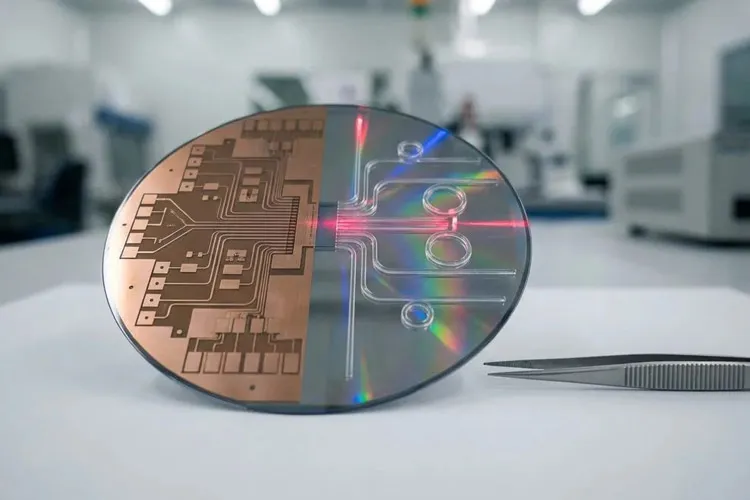
Electronic chips have for decades been the driving engine of almost every digital device, from smartphones and computers to AI servers. But with the steady growth of data volumes in today’s computers, researchers and chip makers have increasingly turned to another way to move and process information on-chip: light.
According to ITNA and quoting Interesting Engineering, this is where photonic chips enter the field. These chips, instead of relying on electrical signals, use photons and tiny optical components to control light.
Electronic chips are built on semiconductor components, especially transistors. Silicon is widely used because of its ability to precisely control electrical properties, enabling the construction of billions of tiny switches in an integrated circuit.
Accordingly, these transistors perform computations and store and process information by turning electrical signals on and off; an extremely mature approach that remains the foundation of modern computing.
The problem is that moving vast amounts of information electrically generates significant energy and heat; an issue that has become increasingly important in data centers, where processors must continuously exchange huge volumes of data.
Photonic chips, also called optical integrated circuits, use light instead of electrical signals for some or all of their functions and can contain components such as lasers, waveguides, modulators, filters, and optical detectors.
It should be noted that these chips do not necessarily abandon electronics, because many systems still require electronic circuits to control optical components and to convert signals between the two domains; this very feature has made silicon photonics attractive by combining the manufacturing advantages of silicon with optical components.