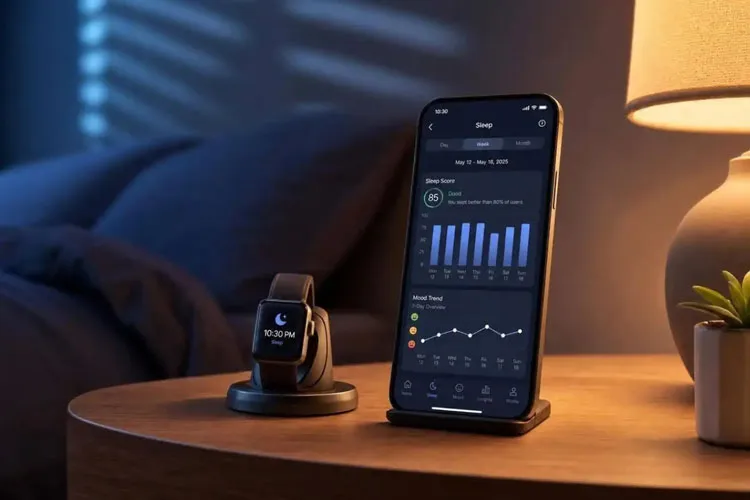
Before you close your eyes, you place your mobile phone beside the bed and the next morning, to start your daily activities, you pick it up again. But during these seemingly quiet hours of the night, your phone is likely collecting data that allows it to estimate when you fell asleep, when you woke up, and even how long you slept - all without you having to open a dedicated sleep app or press a button to start tracking.
This information does not come from a single source; rather, the smartphone extracts it from a wide range of data generated by the device itself as well as from smartwatches, wearables and apps that have been granted access to activity and health information.
Monitoring phone usage patterns
One of the simplest ways a smartphone can estimate your sleep and wake times is by monitoring device usage patterns. When a user stops touching their phone for a long period during the night and then returns to it in the morning, some systems and apps can use this pattern to estimate sleep duration.
This overall picture can also include screen-on time, in-app activity levels, received notifications and various user interactions with the phone. However, the presence of these data does not mean the phone knows the exact moment you fell asleep; in many cases, this estimate is based merely on a recurring pattern in the user’s behavior.
The role of sensors in revealing more information
Today’s smartphones are equipped with a wide range of sensors that, depending on the device model and the permissions granted to apps, can record various kinds of data such as motion, light, sound and location.
For example, a motion sensor can detect whether the phone has remained stationary for a long time; meanwhile, some apps combine other data to create a more comprehensive picture of the user’s daily activity. Of course, the mere existence of these sensors does not mean all data will automatically be used to detect sleep; this entirely depends on the operating system, the app in use and the permissions the user has granted.
Smartwatch; a tool for more accurate estimates
When a user wears their smartwatch while sleeping, the accuracy of this estimate increases significantly. New-generation smartwatches, using sensors such as accelerometers, heart rate sensors and sometimes other specialized sensors, can estimate sleep and wake periods as well as different sleep stages.
By combining temporal, motion and heart rate data, these watches provide a picture of the user’s condition; that is why health and sleep apps, when used simultaneously with a watch or fitness tracker during the night, usually deliver more precise reports. Nevertheless, it should be remembered that these results are still technical estimates and do not replace direct medical measurements of sleep.
Part of a larger health system
Sleep-related data are usually part of a broader health and fitness system. Awareness of a user’s sleep pattern can help apps provide reports of daily activity, suggest suitable times for sleep or waking, and compare sleep information with other metrics such as physical activity and heart rate.
Some services also use these data to personalize the user experience, depending on the nature of the app and the permissions received. An important point is that the sensitivity of this information is not only limited to how it is collected, but also to what it can reveal when combined with other data.
Who owns sleep data?
Users can review the list of apps that have access to health and activity data and revoke unnecessary permissions. It is also recommended to check the privacy settings of the phone and health and fitness apps to determine what types of data are collected and shared and whether these data are stored on the phone itself or in a cloud service.
It should not be assumed that merely installing a health app automatically means the user’s sleep is being monitored; this entirely depends on the app’s settings and the permissions granted to it.
Don’t worry; your phone is not reading your thoughts
Although the idea that your phone knows when you fall asleep may initially seem worrying, the explanation for this phenomenon is usually much simpler than it appears. Your phone does not need to know precisely what happens during your sleep; the device simply collects various signals such as periods of inactivity, motion and data received from a smartwatch or apps and estimates your sleep pattern based on them.
Thus, a smartphone can, without directly receiving information from you, guess when you likely fell asleep and when you woke up. Interestingly, the device that was once simply a tool for communication and entertainment can now sketch an overall picture of our daily habits; from hours of activity and movement to moments of rest and sleep. Nonetheless, the accuracy of this picture largely depends on the data and permissions we ourselves provide access to.