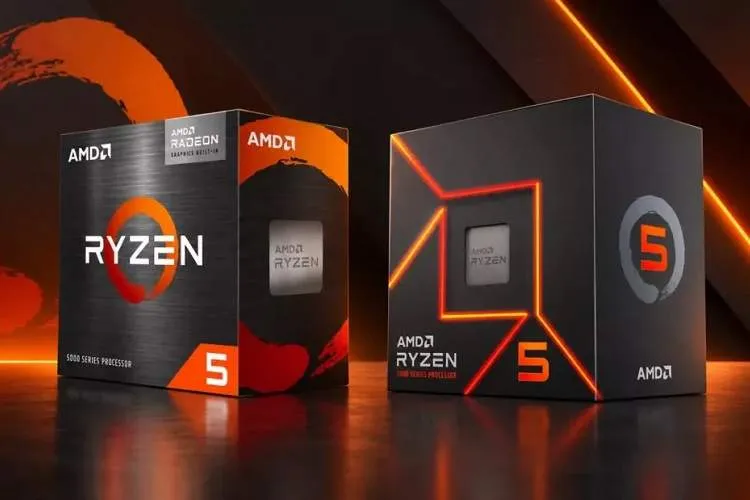
AMD has expanded its desktop processor lineup in both the budget and midrange segments with the introduction of the Ryzen 5 5500F and Ryzen 5 7500. The Ryzen 5 5500F is priced at $99 for users of AM4-socket systems, and the Ryzen 5 7500 is designed for builders of new AM5-based systems at $189.
According to ITNA citing Techspot, the Ryzen 5 7500 is essentially a version similar to the Ryzen 5 7500F but this time equipped with integrated graphics. The chip features 6 Zen 4 cores and 12 threads, a base clock of 3.7 GHz and a boost clock up to 5 GHz. Its total cache is 38 MB, including 6 MB of L2 and 32 MB of L3. The processor’s TDP is 65 W.
The integrated graphics in this model are based on RDNA 2 and have two compute units with clocks that can reach 2.2 GHz. The $189 price of the Ryzen 5 7500 places it below the Ryzen 5 7600 at about $226. Of course, the Ryzen 5 7600 has higher base and boost clocks and will be faster in CPU-bound workloads. In contrast, the Ryzen 5 7500F at about $157 is a cheaper option for users who plan to use a discrete graphics card from the start.
On the other side, the Ryzen 5 5500F has been introduced for AM4 systems. This processor has 6 Zen 3 cores and 12 threads, operates at a 3 GHz base and 4.4 GHz boost, and has a 65 W TDP. Importantly, the 5500F, unlike the Ryzen 5 5500, uses the Vermeer chiplet design and therefore supports PCIe 4.0; whereas the Ryzen 5 5500 is limited to PCIe 3.0.
The Ryzen 5 5500F also has 16 MB of L3 cache and can largely be considered a weaker version of the Ryzen 5 5600. The $99 price makes this processor an attractive option for cheaply upgrading AM4 systems.
These two products show that AMD continues to support users of both platforms; AM5 with DDR5 memory and PCIe 5.0 is the current generation, but AM4 still has many users and the Ryzen 5 5500F can extend the life of those systems at a lower cost.